
Alley Art Project
Season 16 Episode 12 | 25m 35sVideo has Closed Captions
Expressions looks at The Rockwell Museum's long running Alley Art Project
Expressions visits The Rockwell Museum in Corning to look at their long running Alley Art Project. This community project beautifies the city and enriches the lives of the high school students who design and paint the murals. This episode features interviews with key members of the Alley Art team and looks closely at the 2021 and 2022 murals. Adara Alston hosts.
Problems playing video? | Closed Captioning Feedback
Problems playing video? | Closed Captioning Feedback
Expressions is a local public television program presented by WSKG
Alley Art Project
Season 16 Episode 12 | 25m 35sVideo has Closed Captions
Expressions visits The Rockwell Museum in Corning to look at their long running Alley Art Project. This community project beautifies the city and enriches the lives of the high school students who design and paint the murals. This episode features interviews with key members of the Alley Art team and looks closely at the 2021 and 2022 murals. Adara Alston hosts.
Problems playing video? | Closed Captioning Feedback
How to Watch Expressions
Expressions is available to stream on pbs.org and the free PBS App, available on iPhone, Apple TV, Android TV, Android smartphones, Amazon Fire TV, Amazon Fire Tablet, Roku, Samsung Smart TV, and Vizio.
Providing Support for PBS.org
Learn Moreabout PBS online sponsorship(bright music) - [Narrator] This week on "Expressions" we visit the Rockwell Museum in Corning to learn about one of their longest running programs.
- The Alley Art Project is really all about inspiring people and empowering students and artists and just people in our community and really bringing the art outside the building museum walls and really making the art accessible to everyone.
- It's just pleasing to the eye.
And it's so nice to see all of these murals throughout the city of Corning.
- Just seeing that my art is actually a part of something that's in my hometown is crazy to see.
And it's like a lasting imprint that'll be there for hopefully a very, very long time.
- [Narrator] All tonight on "Expressions."
Funding for this program is provided in part by the New York State Education Department, and by viewers like you.
Thank you.
- Hello and welcome to "Expressions".
I'm your host, Adara Alston.
In this episode, we are going to visit the Rockwell Museum in Corning, to learn about their long-running Alley Art project, a tremendous community partnership that was established in 2008 by former director of education, Gigi Alvare.
Gigi spearheaded two years of collaboration that led to the first mural, "Tree of Life," being painted in in 2010.
Since then, the program shows no signs of slowing down and continues the Rockwell museum's long-standing commitment to making art accessible to everyone, whether they set foot in the museum or not.
- The Alley Art Project is also very much connected to the mission and vision of the Rockwell Museum.
While we develop imaginative programming and we display diverse art, we also provoke curiosity, engagement, and reflection about art in the American experience.
And that experience can be shared in the museum, but also out in the community providing access to everyone, to the arts.
- The Rockwell is kind of like a centerpiece on our market street, but for us at the Corning-Painted Post school district, our kids start seeing art across all kinds of mediums very early.
We have kindergarten, first graders being able to see a state-of-the-art museum through the Smithsonian.
That affiliation with them just increases their chances of knowing, understanding and loving art, and how it plays such a critical role in your life and your community.
Art is life, right?
- The community outreach, you know, this building is so beautiful, but they are passionate, and they believe strongly in reaching out and finding those that aren't coming through their doors.
So they go to the schools, and they provide educational programming.
They work with afterschool programs.
Rockwell will go right into the youth centers and give them STEM and art activities throughout the summers.
And the Alley Art Program is, to me, the ultimate example of taking the arts to the street.
- The Alley Art Project, it's a collaboration between the Rockwell Museum and the High School Learning Center of the Corning-Paint and Post Area school district.
We also have a very close partnership with the Gaffer District.
We work very closely with the City of Corning, grant funders, and the community.
And each year students work with the Rockwell Education Department and professional artists in the community, and also professional artists from out of town to create and produce works of art murals on business walls.
- The High School Learning Center is a school that is a result of a collaboration from the Corning-Paint Post school district, Corning Community College, and our local community.
Students who come to the High School Learning Center for whatever reason have been disconnected from their education and their community.
And our goal is to reconnect them, so that they can become solid for whatever they decide to do next in their life.
Just one example, the Alley Art Project of how the students have been able to connect in such a meaningful way that helps them develop as a whole person.
We are not a diploma factory.
We're here to reconnect students.
And this has been one of the most amazing examples of how students have been able to connect with art and with their community.
- There's such a big sense of pride in me that's like, I did that, like, I've put my design there, you know.
Like, just having things out for everybody to see, and, like, the meaning behind all of my art and everything.
That's just something that's so important to me.
And it just means a lot.
- Working with the students is a privilege.
Every mural is inspired by works of art in the Rockwell Museum.
So it's either inspired by a gallery theme, or it could be a specific artwork.
And we use that.
That's sort of the catalyst that that is connected to each year's mural design.
- Students are involved in a design class where they will connect their own experience, feelings and values to works of art in the Rockwell collection for inspiration.
And then they create designs which end up being incorporated into the murals that we have around town.
- They reflect students' thoughts and ideas and reflections, and it's all about sharing different perspectives.
So they're very multifaceted.
A lot of them spark dialogue and conversation, and their art is celebrated in a student exhibition.
We have an opening reception for the community.
And it's at this time where we also unveil the mural design and the location.
That unveiling sort of serves as a way to build excitement in the community.
So it's about, it happens a couple of months before we actually paint.
(bright music) Every mural project has a theme.
The Rockwell Museum has an annual theme for its programming and exhibitions.
The teaching artist or the guest artist for each particular year, you know, works with the Rockwell education team to select artwork that's going to inspire each mural design.
Working with artists, it's kind of a case by case basis.
We started working in the infancy of the program with local artists.
We continue to involve local artists 'cause that's, I think, a very meaningful part of the program.
But then bringing in outside artists, you're exposing students to the expertise of professional artists.
- From the beginning I knew that it was gonna be a community mural with a lot of communal participation, which is what a lot of my murals are.
I started doing public art in 1994, so I've been painting and teaching for a really long time.
So I had a lot of experience working with high school kids.
I had a lot of experience organizing in community.
- Working with Betsy Casanas, she's a muralist and she's very well known in the mural arts community.
And then working with her, she selected our Dene or Navajo textiles as a source of inspiration for the 2021 mural.
- So when I started thinking about life in a tapestry, and it was all symbolic, I wanted the kids to pay attention to past, present, and future.
And of course, the past is something that you can't really do anything about.
When they were thinking about present, it was things that you may have wanted to do, like if you wanted to learn cooking, like really small attainable goals that you haven't started.
So it's like, what can you do in the present in order to make sure that in the future your hopes and dreams, and where you want to be, seems a little bit closer and less like a dream?
- During the design process, we worked with Betsy and she showed us how to create these mandalas.
Circular pattern kind of comes in from the middle and goes out, and it's kinda like equal on all sides.
And I didn't really know how to make these because, you know, I do art, but I've never done that kind of art before, like the patterning and everything.
And we made our own mandalas and then we painted them, and they were on these big sheets, and we put up the mandalas from the sheet onto the actual wall.
- Thought the space was great.
It's a beautiful wall.
It was great that it was right next to Pudgie's Pizza, because you had a lot of the locals coming in and eating and spending time here.
So we had a lot of foot traffic for folks that were just in the area.
And, you know, I mean, it's a local shop, so that's always really nice to be able to support and beautify spaces of small businesses.
- I never really kind of knew how to create public art and murals.
I knew about them, but I'd never been a part of one and I'd never seen the process of one.
Actually being there from the start to the end of creating one, like, opened up a whole new world of figuring out what art can be.
- We will head right back to Corning for more "Expressions" in just a moment.
Now, Betsy Casanas isn't the only international artist the Rockwell has partnered with in the history of the Alley Art Project.
In 2016, the museum enlisted multimedia artist Virgil Ortiz to design the mural "Visibility of Truth."
This piece was based on Ortiz's own sculpture "Ancient Elder," which is part of the Rockwell's collection.
For their 10th anniversary mural in 2018, "The Art of Industrious Minds."
The museum partnered with a pair from their own backyard: local artist Brad Libey, and Corning Community College art professor David Higgins.
And as you are about to see, the Alley Art Project and the college teamed up again for a history making mural in 2022.
- The building was constructed in the nineties, and it opened as a planetarium.
A planetarium with an optical mechanical system.
So, a very traditional system.
Nowadays, that technology is not what people use.
Like you know, we've got city lights, we wanna be able to adjust the stars' brightness, we wanna be able to do things other than astronomy.
So that's where we came to mind with the "Digital Dome," and the idea that it was a multipurpose space and that it was multidisciplinary.
So we have a variety of different classes in here.
- We had already been thinking about expanding the footprint of public art in our community.
So we came up here, we got a tour of the campus, about potential wall spaces and murals, and we learned that the Digital Dome Theater was under renovations.
And then we came across, we walked in the space, there is a blank wall that's over 60 feet long and we're like, "This is perfect."
This is our 14th mural and our first mural that's indoors.
And then as we were planning through the process we realized we'll be painting indoors.
We don't have to worry about the weather.
We don't have to worry about painting late at night.
So there are the benefits to painting indoors.
- It's really nice working indoors, because I don't have to worry about the sun going down.
I don't have to worry about it raining on on me.
Worst that happens is fire alarms get set off by spray paint.
- Tori Burdick is a local artist.
She helped to paint the 2020 mural "Earth Mother," and she's been just really fabulous working with the students, and she's just a very, an incredible artist herself.
She's incredibly talented.
- My first sort of introduction to muraling in the area was 2018 Elmira Street Painting Festival.
I ended up winning second place and I met a woman named Lynn Rusinko there who leads the Elmira Infinite Canvas program.
She suggested that I get into mural work and I ended up doing just that.
Part of why I didn't originally want to pursue arts is because I wanted to feel like I was doing something that was directly aiding a community.
Was when I started actually working with kids and you know, helping them to realize their artistic potential, their visions, that's when it really started to feel like something that I could make a career out of.
So what I did for this year's design was, since we knew the location, we kind of knew certain themes that we would want to incorporate.
I had a very loose concept for how the mural was going to look when we started the design process.
And I had students create their designs in a way that they would be easily incorporated into this mural.
- So the 2022 theme is spark, from inspiration to creation.
So this mural is inspired by two artists in our collection.
Rosalie Favell has a mixed media collage work.
It's a photo montage that explores her heritage and her identity.
So there's lots of symbols and it really also depicts lots of galaxies and night sky scenes, really connecting to her Native American and European background and heritage.
We also looked at artist Robin Tichane, who's from this area.
He grew up in Painted Post, and we have a series of his prints.
They're woodblock prints.
So his prints represent a lot of landscape scenes, and they're very abstract in a way, cuz the lots of layers of color and pigment that he layers on, which is kind of the process that we're replicating.
The idea of layering colors with this wood grain patterning on our mural here.
- I was delighted as they started to do the design, and seeing that they were using a nature theme, and that they were connecting it to not only the Rockwell Museum's art, but also connecting it to our own campus.
And the Spencer Crest Nature and Research Center, the owl in the background, that's the logo for our nature center.
So that was really cool too to have that tie into our campus.
Spencer Crest Nature and Research Center, it is unique to have it on a college campus.
It is 271 acres, so it's a pretty big nature center.
We've got two ponds, 7.2 miles worth of trails.
- One of the first things that I did when I knew that we were going to be painting at this location was, my partner and I, we went and we took several hikes up at Spencer Crest.
I wanted to be up here with a mindset of we need to make a mural for this space, not just for this building, but for this space itself, for the spirit of the college.
We're tying together so many things for these different murals.
I really wanted it to be grounded and connected to the location.
Most of my ideas for art just pop in my head.
They're there, and then I put them on a piece.
But I'd done exercises in the past where I started out with a piece of wood that had an interesting wood grain, and then I tried to get myself to think in a more abstract way to create a piece that worked with the wood.
I was able to locate some local wood slabs that the students worked on, and then I had them create their pieces based off of either the shape of the wood or the wood grain itself.
I had them use that wood as the, I guess, source of their inspiration as well as their canvas.
- My design was very, I wanna say industrial.
I had to like, drill metal into it and put flowers in it.
And it took a little bit out of me because I didn't know what I wanted to do.
I knew that I wanted to incorporate my love for anatomy, but I didn't know what I was gonna do.
And it was very difficult trying to figure out everything, and the technicalities and stuff.
It took a little while to even like the piece itself, cuz I went through that whole creative process of being like, "I hate this, I hate this.
Oh, actually this is great."
- I will make like paper cutouts for the different trees and kind of arrange them.
I had about six feet of these, like, wood panels that I used.
I had to keep in mind the fact that we really only have strong light on this front section right here.
So wanted to host a bulk of the design there.
And then we were going to be walking down the hallway.
It's gonna be dimly lit.
There's not much light.
So we knew, I knew anyways, that we couldn't have a super bright punchy design, because those colors, unless you have a lot of like, vibrant light cast onto them they tend to look almost a little bit more dead.
Yellow can either look like sunshine or it can look like jaundice, and we don't want jaundice.
So I knew that we kind of had to work with the lighting as well.
So the immersive forest theme really translated well.
We basically have created an entire forest on these walls, and the trees that are the most in the foreground, they kind of surrealistically shift.
So instead of just being bark in a single solid color, the insides reveal wood green patterns that host the students' designs.
And those are rendered in like, this really bright sort of silver color that you know, when you first walk through, you don't necessarily notice it until the light catches just right.
And then there's this beautiful design revealed, really like kind of a game of hide and seek to explore the mural.
- I based my design off an old time calligraphy map.
I represented that pretty nice in the tree, and I think it turned out really good.
And I think everyone's unique designs makes it, like, really special.
'Cause it's not all just one theme, it's multiples set across the entirety, all brought together.
- I genuinely love working with high schoolers, especially these guys, just because they have such a great energy.
And I think what's really unique about this group is the way that they are encouraged to communicate with each other and problem solve.
The older students are, you know, responsible for mentoring younger students.
You know, they're expected to have that degree of responsibility.
It's a smoother experience working with them than it is working with maybe some other kids who haven't been put in an environment where they're forced to learn those team building skills.
- Having that sense of belonging to your community is what keeps you here.
And for our students at the High School Learning Center to experience that kind of sense of belonging in their own community, it only increases their chances of staying with us.
But in general, it also adds to the history.
They become part of the history of our community, and part of the history of the Rockwell Museum.
I think in creating community, you need to be immersed in what's happening.
And so this includes our students, it includes the museum, it includes business owners on a market street in Corning Community College to have that mural presence and forever they get to say, "I helped do that.
I helped beautify my community."
- Well, not only do we have the design team but then we have the entire school.
So that's between 30 and 40 students.
We'll come every year and paint and contribute to the mural.
They have ownership in it even if they weren't a part of the design.
After 14 years of having all of those students do that, we've had quite a legacy.
They're connected not only to their community through these murals, but they're connected to the High School Learning Center through the murals and now Corning Community College.
It's a real thread that sort of connects students from various generations from the school.
- Each mural has its own story.
Each mural represents its own narrative and it has its own viewpoint.
So thinking about how we can continue to share those stories, that's sort of how the scavenger hunt was created.
And then we also have labels and plaques at each site with QR codes, so people can go and they could read a very brief description - Fills folks with a sense of pride and dignity.
And that's really important when you're trying to do community work.
- Having something like this on a college campus is like, I think once in a lifetime.
You don't probably don't see a lot of campuses with students painting on it and having a mural on the campus itself.
I think that's something that makes this really special for everyone involved.
- When you see public art in a community, I think it's a sign of a healthy community.
And when you see public art in a community that is created by the youth, then you also get a sense that youth are valued in that community.
Feeling like you're important and like that you can contribute in a positive way does a lot for confidence and feeling connected.
And this is a great mechanism to have that happen.
- I feel incredibly honored, especially because I know how much being a part of this mural making process has touched the lives of the students who were first involved in the program.
Being able to watch that amount of, like, growth in somebody in that short of a period of time especially when you didn't really know them all that well, it's really an honor.
- It's giving these kids the opportunity to give back.
It empowers them.
They feel good about what they've been able to give to the community and that, you know, they're appreciated and that they have a sense of belonging.
So that's a lesson I think people of all ages can learn from.
- These are things to be proud of, and they have really made our community a more beautiful, vibrant place.
And so to have such a lasting impact in such a positive way certainly inspires a lot of confidence and pride in our students.
- If you want to learn more about all the great murals that are a part of this project, visit rockwellmuseum.org/alleyart.
And if you are in the region, I highly recommend you go on the mural scavenger hunt to track down as much of this great community art as you can.
We want to thank Amy Ruza and her Alley Art team for their help putting this show together.
And thank you for watching.
Until next time, I'm Adara Alston.
Good night.
(gentle music)
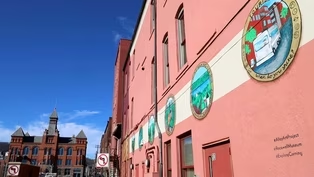
Preview: S16 Ep12 | 30s | Expressions profiles The Alley Art Project (30s)
Providing Support for PBS.org
Learn Moreabout PBS online sponsorship

- Arts and Music
The Best of the Joy of Painting with Bob Ross
A pop icon, Bob Ross offers soothing words of wisdom as he paints captivating landscapes.











Support for PBS provided by:
Expressions is a local public television program presented by WSKG