
May 21, 2026 - PBS News Hour full episode
5/21/2026 | 57m 46sVideo has Closed Captions
May 21, 2026 - PBS News Hour full episode
May 21, 2026 - PBS News Hour full episode
Problems playing video? | Closed Captioning Feedback
Problems playing video? | Closed Captioning Feedback
Major corporate funding for the PBS News Hour is provided by BDO, BNSF, Consumer Cellular, American Cruise Lines, and Raymond James. Funding for the PBS NewsHour Weekend is provided by...
May 21, 2026 - PBS News Hour full episode
5/21/2026 | 57m 46sVideo has Closed Captions
May 21, 2026 - PBS News Hour full episode
Problems playing video? | Closed Captioning Feedback
How to Watch PBS News Hour
PBS News Hour is available to stream on pbs.org and the free PBS App, available on iPhone, Apple TV, Android TV, Android smartphones, Amazon Fire TV, Amazon Fire Tablet, Roku, Samsung Smart TV, LG TV, and Vizio.
Providing Support for PBS.org
Learn Moreabout PBS online sponsorshipAMNA NAWAZ: Good evening.
I'm Amna Nawaz.
GEOFF BENNETT: And I'm Geoff Bennett.
On the "News Hour" tonight: Some congressional Republicans show a greater willingness to break with President Trump over concerns about funding for his proposed White House ballroom and his so-called anti-weaponization fund.
AMNA NAWAZ: The Democratic Party releases the long-awaited and highly controversial autopsy report of its 2024 election defeat.
GEOFF BENNETT: And New Mexico's secretary of state discusses a new law that bars armed federal personnel from polling places.
MAGGIE TOULOUSE OLIVER, New Mexico Secretary of State: Neither the National Guard nor ICE nor any federal entity has a role in the election process.
(BREAK) GEOFF BENNETT: Welcome to the "News Hour."
On Capitol Hill today, a dramatic series of developments unfolded as some Senate Republicans openly broke with President Trump over his request for funding tied to a new White House ballroom and a controversial so-called anti-weaponization fund.
AMNA NAWAZ: Acting Attorney General Todd Blanche made an unplanned trip to Capitol Hill to personally argue the case for that fund.
It didn't work.
Amidst sharp questions and concerns from Republicans, the president did not have the vote he needed and the Senate has instead left town.
Congressional correspondent Lisa Desjardins was there as all of this happened and joins us now with the latest.
Lisa, dramatic day on Capitol Hill, to say the least, leading to at least a temporary collapse of Republicans' reconciliation bill that would fund ICE and CBP.
LISA DESJARDINS: Yes.
AMNA NAWAZ: What happened?
LISA DESJARDINS: Well, per senators in the room from different parts of the Republican spectrum, Republican senators en masse pushed back at the White House today, saying, at least for now, President Trump's request for funding have gone too far.
Now, that has derailed this key bill, at least for now.
I want to look at with that bill, what's at stake here.
That's the Secure America Act.
It's large, as you can see, and it's almost entirely funding for ICE and Customs and Border Protection.
That was poised for passage until the White House and Senator Lindsey Graham added that $1 billion, you see that there, that small slice of this bill, for the ballroom and for security.
That is what started to unravel this, but it wasn't the only problem.
After that, the president and Justice Department announced that $1.8 billion settlement with Trump to establish a so-called weaponization fund to compensate those thought to be politically prosecuted.
That created both political and ideological havoc widely across the Senate Republican spectrum.
So, Senator Thune, the leader of the Republicans in the Senate, called up the acting attorney general today to explain how this fund would work, to try and reassure senators.
He gave them a one-page basically bullet point document over how it would work, trying to reassure them.
The opposite happened.
After about a 2.5-hour meeting, a very tense one, Republican senators instead decided they would go home and pass nothing, because they were not reassured about that fund at all.
AMNA NAWAZ: That one-page document, you obtained a copy of it.
What does it tell us?
LISA DESJARDINS: It is telling in both what it says and what it doesn't.
I want viewers to look at this closely.
First of all, it lays out that the president and specifically his sons are to get no monetary payment from the settlement or the fund, just an apology.
Now, it does not specifically say that's legally binding.
This is all the detail that we have.
Also, how would the billions be distributed?
By five people appointed by the attorney general, who, of course, is appointed by President Trump.
What about the size of the settlement?
That $1.77 billion, it says, is a fair amount because -- quote -- "Literally tens of millions of Americans are subject to unlawful targeting," a huge amount.
Now, this document does not say anything about limiting people who were found guilty of, say, assaulting police officers or other crimes on January 6.
That also was a problem for Republican senators.
AMNA NAWAZ: OK, so that concern over January 6 rioters, in particular, potentially getting compensation from the fund, it's part of this debate.
I know there was a big moment that got a lot of attention on the floor today related to that.
Tell us about that.
LISA DESJARDINS: We paid attention to it.
We spotted this.
This was Senator Tuberville of Alabama.
He just won the primary to be governor of that state for Republicans.
He took to the floor saying that many January 6 defendants should be compensated, and he returned to statements that we know are false.
SEN.
TOMMY TUBERVILLE (R-AL): Let's be clear of what happened that day.
Let's go back and look at it.
Democrats in the deep state, they hated Donald Trump so much that they orchestrated a coup against our government.
LISA DESJARDINS: Now, this, we know, is false.
You and I were both there on January 6.
Those rioters and those who assaulted violently the Capitol and police officers were doing so in the name of President Trump.
I raise this because it is five years later, and this is still coming up from a U.S.
senator.
AMNA NAWAZ: So important to make clear.
Meanwhile we know President Trump is also continuing to face pushback from lawmakers on the war in Iran.
What's the latest on that?
LISA DESJARDINS: Right.
We've seen action this week.
The U.S.
Senate now shifted so that a majority of the Senate this week voted to open the debate about Iran war powers.
And, tonight, Amna, the U.S.
House as we speak was supposed to be voting on that same idea, should the president be able to continue in Iran?
Let's look at what's happening on the House floor right now.
Here's an example of the problems for the president.
Right now, they actually have skipped that vote, something called pulling the bill.
That means they think they would lose that vote, which would have been a strong rebuke for the president.
Even pulling that vote alone shows opposition to the president on Iran is not just growing, but it may in fact be a majority of Congress.
AMNA NAWAZ: Busy day on Capitol Hill.
Lisa Desjardins, thank you.
LISA DESJARDINS: You're welcome.
GEOFF BENNETT: In the day's other headlines: The U.S.
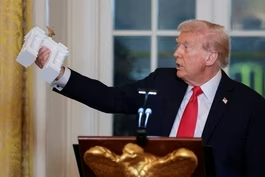
Commission of Fine Arts approved the design for President Trump's proposed 250-foot arch in the nation's capital.
The panel is now made up entirely of President Trump's appointed allies, and today's action moves the arch one step closer to being a reality.
Preliminary surveys and testing of the site started last week, though a group of veterans and a historian have sued the Trump administration to block construction.
Speaking to reporters today, President Trump said he plans to move forward with or without the support of Congress.
DONALD TRUMP, President of the United States: We just got approval from Fine Arts.
That's fantastic.
QUESTION: Right, but do you need Congress to sign off on it?
DONALD TRUMP: No, we don't.
No.
No.
We're doing it.
It's -- the land is owned by Secretary -- by the Interior Department.
We don't need anything from Congress.
GEOFF BENNETT: The proposed site of the arch, Memorial Circle, is located between the Lincoln Memorial and Arlington National Cemetery.
It is managed by the National Park Service, a bureau within the Interior Department, as Mr.
Trump says.
But that land is also considered protected land under federal law that says any monuments built there require congressional authorization.
President Trump and Secretary of State Marco Rubio are escalating their rhetoric toward Cuba, reviving warnings about possible U.S.
intervention.
It comes a day after the administration announced criminal charges against former leader Raul Castro.
During that Oval Office event, Mr.
Trump said, while previous administrations have considered action, he'll be, in his words, the one that does it.
And on his way to a NATO summit in Sweden, Secretary Rubio told reporters he has little expectation of reaching any agreement with Cuba.
MARCO RUBIO, U.S.
Secretary of State: The president's preference is always a negotiated agreement that's peaceful.
That's always our preference.
That remains our preference with Cuba.
I'm just being honest with you.
The likelihood of that happening, given who we're dealing with right now is not high.
But if they have a change of heart, we're here.
And, in the meantime, we will keep doing what we need to do.
GEOFF BENNETT: Cuba's foreign minister quickly accused Rubio of -- quote -- "lying once again to provoke military aggression."
Separately today, the U.S.
Supreme Court sided with the U.S.-owned port business in Cuba whose property was confiscated by Fidel Castro's government back in 1960.
The ruling opens the door for similar claims from other American companies and individuals.
A judge in Minnesota sentenced the former leader of a nonprofit to nearly 42 years in prison for her role in a $250 million COVID era fraud case.
Appearing in court today, Aimee Bock said she failed the public and her family.
Bock ran Feeding Our Future, which claimed to have provided millions of meals to children during the pandemic.
But the Justice Department says she oversaw the single largest COVID-19 fraud scheme in the country.
President Trump used her case and others to initially justify a controversial surge of federal officers to the Minneapolis area last winter.
In Virginia, a judge dismissed all charges today against a former vice principal who was accused of ignoring warnings that a 6-year-old had a gun.
Ebony Parker had faced eight felony counts of child neglect after the student shot and wounded his teacher, Abby Zwerner, at Richneck Elementary school in Newport News back in 2023.
Parker's lawyers had argued she was unaware the child had a gun and the judge said today her actions were not a crime.
The student's mother was sentenced to almost four years in prison for related charges.
The Trump administration is rolling back Biden era rules that require grocery stores and air conditioning companies to reduce greenhouse gas emissions from their refrigerating equipment.
During that Oval Office event today, EPA Administrator Lee Zeldin said the move is meant to help lower food prices.
LEE ZELDIN, Environmental Protection Agency Administrator: Many Americans were expressing a lot of frustration and anger of this rushed, frantic, reckless sprint by the Biden administration to phase out reliable equipment for grocery stores, for restaurants and for homes.
GEOFF BENNETT: Under the new rules, companies will no longer be required to update their equipment to reduce hydrofluorocarbons, or HFCs.
Those are considered super pollutants and are a major driver of global warming.
But it's unclear how much of the projected savings the companies would pass on to consumers, if any.
In Central Africa, concerns over an Ebola outbreak took a violent turn today in the Democratic Republic of Congo.
(GUNSHOTS) GEOFF BENNETT: Local police fired warning shots as tensions flared when friends of a young man who died of Ebola tried to retrieve his body from a treatment center.
According to local officials, after health authorities refused access, the group responded by lobbying projectiles at the treatment center tents, causing a fire to break out.
Separately, a rebel group that controls Eastern parts of the country said today that a person died from the disease some 300 miles south of the outbreak's epicenter.
Authorities have reported at least 148 suspected deaths and nearly 600 suspected cases so far, though officials in Geneva said today the reality could be far worse.
JANE HALTON, Coalition for Epidemic Preparedness Innovations: I have described this outbreak as being like an iceberg.
We have seen the top of the iceberg.
The WHO is now into the many hundreds of cases and hundreds of deaths, but the truth of the matter is the real numbers welcome be much bigger than that.
GEOFF BENNETT: Meantime, a new rule from the Department of Homeland Security took effect overnight that requires all inbound passengers who have recently traveled to the DRC, Uganda or South Sudan to arrive first at Dulles Airport for enhanced Ebola screening.
Only then can they continue on to their final destination.
On Wall Street today, stocks posted modest gains, as oil prices eased.
The Dow Jones industrial average climbed around 275 points on the day.
The Nasdaq added around 20 points.
The S&P 500 also ended a touch higher.
And Robert Woodson, a leader of the Black conservative movement, has died.
His efforts to address racism, poverty and crime made him a sought-after voice among Republican leadership over his six-decade career.
In 1981, he founded the nonprofit Woodson Center, which today called him a visionary leader whose life's work transformed communities from the inside out.
Robert Woodson was 89 years old.
And NASCAR driver Kyle Busch has died.
In a social media post, NASCAR said today that they are saddened and heartbroken at the passing of the two-time Cup champion.
Busch was in his 22nd full-time season in NASCAR's top division and was considered a future Hall of Famer.
Just hours earlier, his family had said he had been hospitalized with a severe illness.
His death has been described as a staggering blow to the motor sports community.
Kyle Busch was 41 years old.
Still to come on the "News Hour": tensions rise in the Baltic nations as Russia's invasion of Ukraine spills over; a Stanford student's new book exposes the university's complicated and at times complicit relationship with Silicon Valley; and Stephen Colbert hosts the final episode of "The Late Show" after its cancellation.
The Democratic National Committee released along the way did, yet still incomplete report into what went wrong during the 2024 presidential election.
The report had initially been shelved, but, after months of consternation and criticism, DNC Chair Ken Martin said he released it today in the name of transparency.
He also said it -- quote -- "wasn't ready for prime time" and rejected its findings, writing this: "I am not proud of this product.
It does not meet my standards and it won't meet your standards.
I am releasing the report as I received it in its entirety, unedited and unabridged with annotations for claims that couldn't be verified."
Those annotations are found throughout the 192 pages.
The report blames Joe Biden's political team for not positioning Kamala Harris for success.
It also says Democrats didn't effectively make the case against Donald Trump.
There are also omissions.
The report does not mention Mr.
Biden's age or the war in Gaza and how opposition to it may have depressed Democratic enthusiasm.
Joining us to discuss what the party got right and wrong and how to move forward into the midterm elections is Democratic strategist our friend Faiz Shakir.
Faiz, it's good to see you.
FAIZ SHAKIR, Democratic Strategist: Hi, Geoff.
GEOFF BENNETT: So, this report is riddled with errors.
There are notes saying -- quote -- "no evidence provided, analysis not supported by the data."
There's even a missing conclusion with a note saying, "This section was not provided by the author."
What do you make of the way that this was handled?
FAIZ SHAKIR: Well, it was handled poorly.
And I think, obviously, Ken would probably acknowledge that, the chairman of the DNC.
What are people looking for at this moment?
They're looking for leadership and they're looking some sense of integrity of, can you diagnose restoring the Democratic brand?
In my view, it is suffering with working-class people.
In this age of Trump, it should be booming.
The Democratic Party should be the place, the home of so many people, not only Democrats, but so many independents who are feeling disaffected.
What is the brand problem?
And I think the report is more a symptom, rather than the cause of the problems.
It's a symptom because there's a sense of unwillingness to talk about hard issues, confront difficult questions.
Let's have a debate.
Let's discuss reform.
Let's not be status quo.
And people look at this report and the process by which it is now released as saying, that's the problem.
We're walking on eggshells.
We can't even have hard questions.
Let's confront some real problems and have bold solutions to reform a broken system.
GEOFF BENNETT: There's a striking line in this report suggesting that Democrats became too dependent on what is called in this report negative partisanship, essentially asking voters to fear Republicans rather than believe in Democrats.
Is that a fair criticism?
FAIZ SHAKIR: It's still the case, Geoff.
We're still in a moment -- if you hear most Democrats talk right now, you will hear a thing like the Epstein class.
And I'm here to tell you, yes, there's an Epstein class.
They're corrupt.
Yes, but what people are hunting for is, give me a sense of a vision that isn't the Epstein class.
And when too many people are thinking, oh, the Epstein class is a version of both sides having problems, right, Democrats and Republicans.
So now the choice is, OK, if you're going to take on corruption, give me a vision.
Give me a sense of a party that's saying, oh, I'm going to expand health care in America.
Here's how.
I'm going to tax the rich.
Here's how.
I'm going to build a grassroots movement in America, find working-class people, bring them into the process, change the institutions.
People are feeling like this is the time to break the way we have thought in the past and put forward an agenda.
Right now, as you and I speak, there is not a Democratic agenda for 2027, right?
We are not going before the American public saying, here's four or five things, vote Democrat.
Why?
It's negative partisanship.
It's the thing that you just raised.
We're still stuck in status quo thinking.
GEOFF BENNETT: Kamala Harris could not be accused, though, of not having policy prescriptions.
I mean, it is part of the problem here that Democrats are facing a Republican Party that rewards power and grievance and not traditional policy arguments?
FAIZ SHAKIR: Well, there's a combination of the politics and the policy.
They're at work here.
Part of Donald Trump's politics that we can learn from is that he says no tax on tips.
That's a policy, right?
But then he goes and animates it and he does it -- dons a McDonald's apron and he gets your attention.
Now, when we come up with great technocratic policy solutions, which many of which I agree with, if you looked at Harris' platform, it isn't just merely writing them on a page and telling people this is something to vote for.
You got to go animate it.
How do you animate, Geoff?
Well, you got to pick some fights.
The way you choose to decide what are your values, what you care about is when you say to Jeff Bezos, we're going to tax the rich.
And then Jeff Bezos gets very angry and upset about it.
And you see what's going on with Zohran Mamdani in New York City.
Why is his popularity increasing?
Because he is comfortable in the friction.
He is saying, here's a vision.
Here's how we can increase taxation.
Here's how we can provide childcare.
Yes, some people can take me on.
But are you with me or are you with the corrupt class?
And that is a kind of a leadership that I think we need more of across the country.
GEOFF BENNETT: Some Democrats are now calling for Ken Martin to step aside, step down as the DNC chair ahead of the midterms.
You ran against him for that job.
How do... FAIZ SHAKIR: Got all of two votes, Geoff.
(LAUGHTER) GEOFF BENNETT: Hey, it's two more votes... FAIZ SHAKIR: He won.
He won fair and square by a healthy margin, to be fair.
GEOFF BENNETT: Two is more than zero.
I guess we can say that.
But how do Democrats move forward from here?
And frankly, do they need a DNC, a strong DNC,to win the presidency?
The DNC -- Barack Obama didn't rely on the DNC much at all.
FAIZ SHAKIR: For sure, we do need a DNC.
And this time -- it's not only the DNC, by the way.
We need strong media institutions.
We need a strong PBS.
We need strong institutions of learning, Harvard University, and everything else in between.
And I think there's a loss of confidence in institutions right now.
And what my pitch, my argument would be -- because I hear from a lot of Democrats, oh, the DNC can't do anything.
Why are you worried about it?
Like, in this time of great wealth and income inequality, solidarity is the thing.
And the solidarity of people can only be built by good institutions of integrity.
We need institutions to work.
We need the DNC to work.
So don't give up on it.
And I think I would urge DNC leadership, everybody who's invested in it, you got to reform it.
You got to acknowledge it's broken.
Just as we know about the political and economic system in America, you have to start by acknowledging it is broken.
And the Gaza thing, you mentioned.
Why don't you mention Gaza?
It's not about Gaza.
It's about the influence of money.
Money is buying, purchasing silence.
We're not even discussing the fact that 75 percent of Democrats say they want to oppose military aid to Netanyahu.
Can we just have the conversation?
We should be able to.
That is leading to an erosion of trust in an institution.
A good institution just says, hey, we're going to have some tough questions.
We're going to reform this.
We're getting acknowledge it's broken.
And we're going to improve it.
GEOFF BENNETT: Faiz Shakir, always a pleasure.
FAIZ SHAKIR: Thank you, Geoff.
AMNA NAWAZ: Today, over two NATO countries, jets raced across the skies to shoot down drones.
It's the latest example of at least a half-a-dozen drone incursions in the Baltics just in the last week.
The nations along NATO's Eastern flank have long been on the front line against Russian aggression, but now they're in the firing line between Ukraine's long-range drones and targets in Northwest Russia.
Nick Schifrin talks to Latvia's foreign minister and reports on NATO's efforts to defend itself against a growing drone threat.
NICK SCHIFRIN: Today in Latvia, fighter jets scramble to intercept a drone for at least the third time this month.
But this drone and the one that hit this Latvian oil facility earlier this month and these drone shards shot down by a NATO jet over an Estonian field were Ukrainian, not Russian.
And this week in Lithuania, suspected Ukrainian drones forced government leaders to shelter in a bunker beneath Parliament, the first time that's happened in a NATO capital since Russia launched its full-scale invasion of Ukraine more than four years ago.
BAIBA BRAZE, Latvian Minister of Foreign Affairs: Russia is, of course, attacking Ukraine, and Ukraine is doing itself-defense.
So it's flying drones into Russia, and then Russian electronic warfare, of course, misdirects them.
And then sometimes they fly into our airspace.
NICK SCHIFRIN: Baiba Braze is Latvia's foreign minister.
We spoke while she attended a NATO summit in Sweden.
She and other Baltic leaders say the Ukrainian drones were forced off course by Russia.
But other European officials have wondered whether the Ukrainian drones were autonomous and chose their own incorrect targets.
BAIBA BRAZE: The two drones that were examined were found not to be those type of drones, so I won't release any further information, as it's classified.
Let's remember, if it was not for Russia's wars -- war against Ukraine, these incidents wouldn't happen.
So it's Russia's fault.
NICK SCHIFRIN: Russia accuses Latvia specifically of allowing Ukraine to use your airspace for drone attacks in Russia and even to launch attacks.
Is that true?
BAIBA BRAZE: Russia has been lying for whatever -- I remember, since I remember myself, there have been lies from the USSR, from Russia.
So don't believe what Russia says, especially the official representatives.
And the truth is that, of course, we are not providing anything to Ukraine's attacks.
We are not providing airspace.
We are not providing our ground.
We are not providing anything.
NICK SCHIFRIN: Is Ukraine being careful in its targeting and its -- and the paths that it is sending these drones on?
BAIBA BRAZE: We have been in touch with Ukrainian officials with very clear message that our space is out of limits.
And they know that, so they haven't violated anything.
NICK SCHIFRIN: Ukraine's targets are in Russia along the Baltic Sea or next to the Baltic states, all three of which are former Soviet republics, including the largest ports where Russia exports oil, hoping to disrupt the Kremlin's most important source of income.
BAIBA BRAZE: Russia is trying to hide its inability to achieve its military objectives and the fact that Ukraine has these successful technologies and Russia cannot defend against them.
NICK SCHIFRIN: But Russian drones also pose a threat to NATO, and NATO is struggling to keep up.
NARRATOR: The nature of warfare is changing.
NICK SCHIFRIN: NATO does not yet have unified counterdrone capabilities in the eastern flank, and so is launching new initiatives along the Russian border.
NARRATOR: With it, we fight as one.
NICK SCHIFRIN: Today, NATO still has to scramble jets and use expensive missiles to target cheap Russian drones.
And it's difficult to detect different types of Russian drones as they cross the border.
BAIBA BRAZE: The truth is, none of NATO's countries has the battlefield like Ukraine has.
And so we have to make sure that our transformation is faster, that it's massive, that we have all what is necessary to defend, but also to be ready.
So there are big lessons still to be learned for all of NATO allies.
NICK SCHIFRIN: The Baltics are on the front lines, and they conduct exercises in case of Russian invasion and have built border defenses that didn't exist before Russia's full-scale invasion of Ukraine.
They have also realized the Ukraine war has become a drone battle and the best source for lessons learned.
BAIBA BRAZE: Ukraine has the most advanced data, most advanced technology, because it's fighting for its existence.
And it has been great at innovation, and it has been great at the upgrades within few weeks and doing everything that needs to be done in the situation of war.
So, none of NATO states is in that position.
However, we are indeed working with the Ukrainians, and we are carefully following also what Russia is doing, because Russia is also learning.
NICK SCHIFRIN: And so it's a race of learning and innovation of how best to defend NATO, even when it's inadvertently from a partner.
For the "PBS News Hour," I'm Nick Schifrin.
GEOFF BENNETT: With primary season already under way, election officials are preparing for November, and some Democratic-led states worried about the possibility of armed soldiers or ICE officers appearing near polling places are taking steps to counter what they see as a potential effort to intimidate voters.
Our Liz Landers has more.
LIZ LANDERS: This week, Connecticut's governor signed into law a measure that expands no-excuse absentee voting, while also restricting armed federal agents near polling places.
Portions of the law were modeled on New Mexico, which earlier this year became the first state to pass such a ban near polling places.
Joining us to discuss how states are dealing with election security and voter intimidation concerns is Maggie Toulouse Oliver, the New Mexico secretary of state.
Madam Secretary, thank you for joining "News Hour."
MAGGIE TOULOUSE OLIVER, New Mexico Secretary of State: Thank you for having me.
LIZ LANDERS: So, federal law dating back to the Civil War already bans sending the military or other -- quote -- "armed men" to polling places in most instances.
But I asked President Trump about this recently, Here was our exchange.
The midterm elections, would you send the National Guard or ICE to voting locations in November?
Would you do that?
DONALD TRUMP, President of the United States: Well, you know what?
I would do anything necessary to make sure we have honest elections.
We have to have honest elections.
LIZ LANDERS: So you're not ruling that out?
What enforcement mechanism does the state have in the moment if armed federal forces show up at the polls?
MAGGIE TOULOUSE OLIVER: Well, the good news is, here in New Mexico, we recently passed some legislation to address this very question, because, in reality, neither the National Guard nor ICE nor any federal entity has a role in the election process or a responsibility or the power to interfere in the election process.
And, in fact, as we know, going back to the Jim Crow days, any involvement of law enforcement or the military can be perceived as intimidation by voters.
And so we passed legislation here in New Mexico this year, Senate Bill 264, that not only prohibits agencies like ICE from interfering in the election process, but it also creates both civil and criminal penalties.
For example, it will be a fourth-degree felony if either an agent of a federal agency like ICE or a superior who orders them under color of law to interfere with the election process.
They will be prosecuted here in New Mexico.
LIZ LANDERS: Does that mean that if you got a call from a clerk that said there are ICE agents close to a voting location, that you would then call a sheriff?
Or what would you do in that moment?
MAGGIE TOULOUSE OLIVER: Here in New Mexico, like many other states, we have a number of partners, law enforcement and otherwise, that we work with during the election process.
So, in New Mexico, we work with local police, State Police, county sheriffs, and Homeland Security.
And what we could do in that situation, depending on who was the closest and who had jurisdiction, is, we could ask an individual -- even a representative from the attorney general's office, say, a deputy attorney general, could go and inform the individual that may be in violation of our state law that they are in violation of state law and could incur civil or criminal penalties if they don't leave immediately.
LIZ LANDERS: This law also introduces new penalties for anyone opening a ballot box or opening a voting machine if they are not permitted to.
Why was that necessary?
MAGGIE TOULOUSE OLIVER: Well, I mean, I think many of us in the election world and many just average folks are aware of the situation that happened this last year or so in Georgia, where federal agents went and sort of took over a local election office and took records, et cetera, to conduct, again, some sort of a red herring investigation based on really going back to what we refer to as the big lie from 2020, in other words, that the election was stolen when it was not.
And so those records are sacrosanct.
If they are taken out of the possession of the appropriate officer, in this case in New Mexico, the county clerks, that can create huge problems, potential privacy violations, et cetera.
And we wanted to prevent that from happening in New Mexico as well.
LIZ LANDERS: Have you heard any response from the federal government after this law passed?
MAGGIE TOULOUSE OLIVER: We have not heard anything directly from the federal government regarding our particular legislation that we have passed here in New Mexico.
To the extent that we have heard anything, it's been through a game of telephone, third party, for example, the question that you asked the president recently that we hear through the media, but we have not received any direct contact about the legislation.
LIZ LANDERS: What is your biggest fear about election security in these upcoming midterms?
MAGGIE TOULOUSE OLIVER: I think my biggest fear has been and continues to be the perception that our elections are not secure.
Our elections are incredibly secure.
The folks that are running elections around this country are incredibly dedicated to following both federal and state laws and to ensuring that every eligible voter can cast a ballot.
So I think, first and foremost, that misinformation about the security of our election process can be extremely damaging.
We are prepared for potential cyberattacks, potential physical, not only attacks, but attempts to interfere in the election process.
And I think our fears at the end of the day come down to, what scenario have we not already thought of?
What are we not already prepared for?
LIZ LANDERS: New Mexico was one of many states the Department of Justice has requested to turn over your voter rolls and private voter data.
When your office did not comply, the DOJ sued New Mexico and you personally.
Why did you refuse?
MAGGIE TOULOUSE OLIVER: Well, so New Mexico is one of a handful of states, first of all, that uses the full Social Security number for voter registration in order to identify voters and ensure that there are not duplicates, ensuring that individuals are not pretending to be the voter on their behalf.
And so, for us, that is the gold standard, and we want to maintain that, even the last four of a Social Security number, but especially a full Social Security number and a full date of birth.
Those are the keys to identity theft, right?
And we are not in the business of sharing that data with anybody for any reason, other than to do our job as election officials.
LIZ LANDERS: New Mexico Secretary of State Maggie Toulouse Oliver, thank you for your time.
MAGGIE TOULOUSE OLIVER: Thank you.
AMNA NAWAZ: While most college freshmen spend their year shopping around courses and picking their majors, Theo Baker had a bit more on his plate.
As a reporter for The Stanford Daily, Theo's investigation into research misconduct brought about the resignation of Stanford President Marc Tessier-Lavigne.
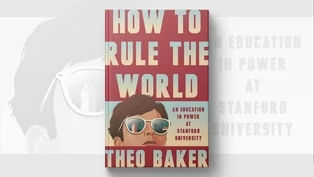
Baker chronicles that investigation and a secretive culture of access, money and big tech influence on campus in his new book, "How to Rule the World: An Education in Power at Stanford University."
I spoke with him about that book recently.
Theo Baker, welcome to the "News Hour."
Thanks for being here.
THEO BAKER, Author: Thank you for having me.
AMNA NAWAZ: So you arrive at Stanford in 2022 as an incoming freshman after dreaming of attending the school from a very young age, right?
You write in the book, college is about reinvention.
What did that mean to you?
What did you imagine your college life would be when you got there?
THEO BAKER: Well, you're right that Stanford was a dream of mine.
I fell in love with that place when I was 7.
I remember seeing this image of these kids who were wearing their Stanford T-shirts and their flip-flops and lounging in the shade of a palm tree leaning up against the self-driving car they just helped to build.
I just thought this was the coolest place in the world.
The future is being made by these amazing teenagers who are off in Northern California.
AMNA NAWAZ: Yes.
THEO BAKER: I arrived and very quickly I learned that things were not exactly as I thought.
AMNA NAWAZ: You write about the Stanford within Stanford, one where students who have ambition and a potentially really good start-up idea get plucked, as you put it, right?
V.C.s are flooding the campus, trying to pour money and time and resources into some of these students.
You wrote this that struck me.
You said: "A study once determined that V.C.s," venture capital funds, "fund only one company for every 100 they review.
Not so for Stanford's undergraduate elite.
V.C.s seek out this network aggressively, even employing older students as talent spotters."
Tell me about that.
What does that do to the culture at a place like Stanford?
THEO BAKER: Yes.
Well Silicon Valley has been, by some metrics, the greatest concentration and creation of wealth in human history.
And so if this is a modern-day gold rush, the resource to mine is talent.
And the earlier you can find it, the more you make your own career by getting in on the ground floor of the next Google or Instagram.
So these teenagers, the second they step on campus, are being assessed for whether or not they are the -- quote -- "wantepreneurs," who just want to do it because they want to make their billions, or if they're going to be the so-called builders, those who actually have it in them.
AMNA NAWAZ: How is this different, though, from, say, like financial firms or consulting firms reaching deep into business schools or into the Ivies in the Northeast... THEO BAKER: Yes.
AMNA NAWAZ: ... mining for talent for people that they want to hire eventually?
THEO BAKER: Yes.
AMNA NAWAZ: What's different about it?
THEO BAKER: So I think people are well aware of the privileges of the Ivy League and the pipeline to Washington and Wall Street.
Stanford is so much more entangled with Silicon Valley.
Silicon Valley wouldn't exist without Stanford.
It was created at the Stanford Research Park.
If you just take the value of the companies that have offices on Stanford land, it's somewhere north of $6 trillion.
So it's completely integrated.
Stanford even has its own V.C.
fund to seed students' new companies.
That said, what we're seeing at Stanford really is the vanguard of a trend that sweeps higher education, right?
It's the sort of extreme and concentrated version.
Just as Silicon Valley trends tend to filter out into the rest of society, so too do the things at Stanford.
AMNA NAWAZ: And so you arrive there, you see this culture, you see what's going on, and even though you're turned off by it, it seems, you really do try to jump into it, embrace it, right?
You want to be a part of it.
You want to navigate it.
Tell me why.
THEO BAKER: Look, it's an intoxicating system.
And I hope that I capture that seduction in the book, because how can you as a teenager say no to this?
It's ridiculous, right?
It's -- imagine being the teenager, being offered the yacht parties and the slush funds.
And it's all just so absurd.
I remember this Silicon Valley CEO who started a billion-dollar company reaching out to me cold in freshman year.
So he takes me out for brunch at the Rosewood, and he's wining and dining me I guess.
And he's spoon-feeding his eight-month-old caviar as he confesses that his first ever contract was for Moammar Gadhafi.
And it was just a ridiculous scene, but it also speaks to the sort of casualness of misdeed in this system, right, where actually it isn't just that this is absurd.
It isn't just that teenagers are being handed this excess and access that is ridiculous by any objective metric.
It's that it also inculcates a series of deceptive and fraudulent business practices that we see emerging all too frequently from this insider system.
AMNA NAWAZ: Well, you end up making a name for yourself down another path at Stanford, which is the fact that, despite both your parents being renowned journalists, you make very clear you don't want to pursue journalism, and you kind of do it as a hobby at Stanford, it seems like.
But before the end of your freshman year, you report out a story uncovering research misconduct in scientific papers that were co-authored by the powerful Stanford president, Marc Tessier-Lavigne, and that reporting ultimately leads to him being ousted from his post.
What was it about that story that made you want to chase it so hard?
THEO BAKER: Well, it was definitely not at the end of the day the story that I expected to be reporting on in freshman year.
I arrived.
I thought that the student paper would be something I did as a tribute to my grandfather, who passed away just before I arrived and really loved his time as a college reporter.
And I discovered these image alterations in papers that had been co-authored by the Stanford president by looking at these forums that these comments had popped up on in 2015, so seven years earlier, that had never been followed up on.
So I began my reporting process there and spent the next 10 or 11 months really digging into Marc Tessier-Lavigne's labs, ultimately establishing that there was a pattern of papers that emerged at different institutions in labs that he oversaw in which papers had emerged with falsified data and that, when issues were brought to his attention, in the judgment of the eventual Stanford investigation, he failed to decisively and forthrightly correct errors in his research.
AMNA NAWAZ: But, Theo, I want to be clear about.
This wasn't like you got a tip and you wrote a report.
You chased this story.
You got waved off this story by powerful people who knew him well, said, don't do it.
You were threatened with lawsuits.
That would scare off a lot of seasoned journalists.
Why didn't it scare you?
THEO BAKER: Well, it's not that I wasn't scared.
I mean -- and this book I think makes very clear that I certainly was rattled at many points, that I didn't always handle the pressure all that well personally.
But at the end of the day, it was very clear that, as a student journalist, you have no higher calling than reporting on your own administration.
And I knew that research misconduct is an issue that goes overlooked far too frequently.
No one else was doing this reporting.
And so it was up to us at the student paper to figure out whether or not there was a story here and what actually we needed to know about our president.
AMNA NAWAZ: You write, obviously, about the very high highs that you experience and then, like all college freshmen, anyone navigating the real world, the very low lows.
And you write very honestly about a harrowing experience in which you essentially overdose on opiates that were prescribed to your grandfather.
Tell us about why you wanted to be so honest about that moment and what it's like to reflect on that now.
THEO BAKER: Yes.
Yes, I mean, this is not an easy thing to write about, certainly my lowest life moment.
But I wanted to tell a three-dimensional story, right?
I want to look at Stanford as an institution that has produced so much innovation and also fraud.
I want to look at the students that I'm arriving with who have so much promise, and yet also learn how to cut corners.
And I didn't feel that this would be an honest book if I didn't apply that same standard to myself and show the true reality of what this story looks like, right, which is not always an easy, simple triumphalist narrative, right?
Life is never quite so simple.
The whole book revolves around the appearance of perfection.
That is the central theme of Stanford, that this school needs to appear perfect.
And I certainly didn't want to model that behavior myself.
AMNA NAWAZ: I should point out you are weeks away from graduating.
THEO BAKER: I am.
AMNA NAWAZ: What's next?
THEO BAKER: I don't know what's next, but I will say that I'm going to walk across that stage and be just as happy and grateful as anyone.
And Stanford is a place with deep issues.
It has made this Faustian bargain with Silicon Valley that has allowed for its ascent, has made it into this incredible powerhouse of university and allowed for its corruption.
But at the same time, I view this reporting as, to me, an act of love, that I'm not doing this because I want to tear down the institution.
I'm doing it because I think, if you love something, you want it to be better.
And I think it's time for us to honestly reckon with both the good stuff that Stanford is really good at promoting and the part that too often gets swept under the rug.
AMNA NAWAZ: The book is "How to Rule the World."
The author is Theo Baker.
Theo, thank you so much.
Such a pleasure.
THEO BAKER: Thank you.
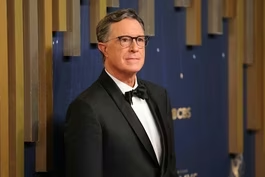
GEOFF BENNETT: Tonight, the curtain closes on "The Late Show With Stephen Colbert" and on more than 30 years of late-night TV history.
Colbert has entertained and provoked from the historic Ed Sullivan Stage for the last decade in ways that transformed the comedic landscape.
We take a look now at what led up to this inflection point and what it might mean for the future of late night, part of our arts and culture series, Canvas.
STEPHEN COLBERT, Host, "The Late Show With Stephen Colbert": Welcome to "The Late Show," everybody.
I'm your host, Stephen Colbert.
GEOFF BENNETT: After 11 seasons, "The Late Show With Stephen Colbert" will go dark tonight.
Long the top-rated late-night talk show, Colbert interviewed politicians.
Hello, Mr.
Obamer?
Am I pronouncing that correctly?
BARACK OBAMA, Former President of the United States: Close enough.
GEOFF BENNETT: Comedians.
STEPHEN COLBERT: I didn't know there were any mongoose in Peru.
WILL FERRELL, Actor and Comedian: No, there's just one, this one.
(LAUGHTER) GEOFF BENNETT: And musicians.
STEPHEN COLBERT: What?
NICKI MINAJ, Musician: Are you married?
(LAUGHTER) STEPHEN COLBERT: Why?
Why?
Yes, yes, I am.
Yes, I am.
I'm married.
NICKI MINAJ: Oh.
GEOFF BENNETT: His wife, Evie McGee Colbert, was a regular.
EVIE MCGEE COLBERT, Wife of Stephen Colbert: On our first date, I said, "You play any sports?"
And he said, "I play hacky sack."
GEOFF BENNETT: Colbert took over the show from David Letterman in 2015 after a decade hosting the Comedy Central news satire "The Colbert Report," which was a spin-off of "The Daily Show."
His old friend Jon Stewart was among his final guests.
JON STEWART, Host, "The Daily Show": Oh, are you going to enjoy watching "Matlock" in this mother (EXPLETIVE DELETED)?
GEOFF BENNETT: CBS announced "The Late Show"'s cancellation last July, insisting it was a purely financial decision.
The program was reportedly losing millions of dollars each year, but many believed politics was at play.
STEPHEN COLBERT: Welcome to Trump's golden age, by which I mean it's time to start melting down grandma's gold.
GEOFF BENNETT: Colbert's regular roasts drew the ire of President Trump.
The president posting: "Stephen Colbert is a pathetic train wreck with no talent or anything else necessary for show business success."
Many observers saw the cancellation as an effort to appease Mr.
Trump at a time when CBS parent company Paramount was finalizing a merger that required government approval.
Last fall, Colbert told Jimmy Kimmel he was surprised by the news, which he got from his manager, James "Baby Doll" Dixon.
STEPHEN COLBERT: So I said: "Evie, I will be home a little bit later.
I got to talk to Baby.
He wants to talk for 15 minutes."
And I come home 2.5 hours later.
And she - - I walk into the apartment and she goes: "What happened?
Did you get canceled?"
JIMMY KIMMEL, Host, "Jimmy Kimmel Live": No?
STEPHEN COLBERT: Yes.
JIMMY KIMMEL: Really?
STEPHEN COLBERT: I said: "Yes, I did."
GEOFF BENNETT: Kimmel and fellow late-night hosts Seth Meyers, John Oliver and Jimmy Fallon, who co-hosted the "Strike Force Five" podcast with Colbert back in 2023, reunited on the show last week.
STEPHEN COLBERT: What is my status?
Do I become emeritus?
SETH MEYERS, Host, "Late Night With Seth Meyers": You're just hard out.
You're just out.
STEPHEN COLBERT: I'm just out.
SETH MEYERS: Yes, it's Strike Force Four.
And it breaks our heart.
SETH MEYERS: It's like -- but it's like -- it's like gerrymandering.
Like, nobody likes it, but, like, once the courts rule, it is what it is.
STEPHEN COLBERT: Has the court ruled on Strike Force Five?
JIMMY KIMMEL: Don't worry, give me a few months, it'll be Strike Force Three.
GEOFF BENNETT: Kimmel's late-night show was temporarily suspended last year under pressure from the Trump administration.
JIMMY KIMMEL: "When is ABC fake news network firing seriously unfunny Jimmy Kimmel?"
GEOFF BENNETT: And, in April, the president and first lady called for Kimmel's firing.
JIMMY KIMMEL: Trump has three wars going on right now, Iranians, Ukrainians and comedians.
GEOFF BENNETT: Politics aside, the economics of late-night television are challenging.
Viewership across networks is down, as is advertising revenue.
CBS says it will air "Comics Unleashed" with Byron Allen in "The Late Show"'s time slot.
I spoke with comedian and producer Larry Wilmore, who previously hosted "The Nightly Show With Larry Wilmore" on Comedy Central, about what this moment says about comedy, television, and the changing late-night landscape.
You have occupied a unique space in comedy, former late-night host, cultural critic, political observer.
When you heard "The Late Show" was ending, what was your initial reaction?
(LAUGHTER) LARRY WILMORE, Comedian and Writer: I just didn't know what to think really.
Was it a network decision?
Was there pressure from the president or whatever, which is very bizarre?
We have never had TV shows kind of be determined by the direct political intervention of the president.
I think maybe the closest was "The Smothers Brothers," which was canceled in 1968.
They had a lot of pressure during that time.
DICK SMOTHERS, Comedian: OK, what do you want to sing for us?
TOM SMOTHERS, Comedian: Well, if I told you what it was, you would probably say it was controversial and you wouldn't let me do it.
LARRY WILMORE: I don't think since then we have had a president directly comment on that situation.
So I was very, very confused, wanted to do -- look into it myself and see what really happened, but very surprised to him.
GEOFF BENNETT: Well, CBS is framing the end of "The Late Show" With Stephen Colbert" as a financial decision.
Do you buy that argument?
LARRY WILMORE: I mean, that's what they say.
I mean, the thing is they're not wrong with those arguments.
Just it can be far from right, though.
Maybe it's not the whole argument, because, of course, the show costs a lot.
But a lot of times these places they will have shows on the cost a lot, but they will have some cultural significance for them.
So maybe if it's not bringing that cultural significance, maybe they don't want it around.
But I can't talk for CBS.
I don't know.
All I can do is make things up and figure it out for my own.
But it's not like Lyndon Johnson was trying to get "The Beverly Hillbillies" off the air commenting on it.
Like, since when does the government have anything to do with these decisions?
So there does seem something kind of sneaky going on with CBS kind of listening to other factors.
GEOFF BENNETT: How much pressure, though, exists now, either overtly or subtly, on comedians and networks when you have comedy that intersects directly with politics, as was the case for Stephen Colbert?
LARRY WILMORE: Well, I think the Colbert thing is in its own category.
But look at what happened with Kimmel.
Kimmel's like in a real back-and-forth with the president himself and now the first lady.
I mean, Geoff, I have never seen anything like that.
It's very bizarre.
It almost makes his place more secure.
Like, you almost want to see somebody up there throwing those grenades or whatever it is.
But I kind of get what you're saying.
On the other hand, when you're dealing with corporations like Disney or NBCUniversal or some of these things, who knows what their appetite is for that type of involvement, especially if they're trying to get licenses renewed or trying to get these deals done, the corporate part of it?
So it's in kind of a precarious place.
But, ironically, I think the Kimmel situation, it kind of makes a case for him staying around longer.
GEOFF BENNETT: Late night once created shared national conversations.
That was the case with Johnny Carson and Leno and Arsenio, Letterman.
Are we losing sort of the last space where Americans laughed and -- laughed together and processed things together simultaneously?
LARRY WILMORE: I think so.
I think it's because of that reason.
I think people see it as a divided place already.
So a lot of people don't even show up for it because they hear like they're hearing the other person's side of something.
So why should I listen to that?
And now there are other places for that ideological divide.
If you look at like what Greg Gutfeld is doing on FOX, a lot of people tune into his show for the type of comedy and the angle that they want to hear from.
GREG GUTFELD, FOX News Anchor: What is it with these Democrats and spies?
LARRY WILMORE: I'm surprised there aren't more shows like that, to be honest.
I thought we would see more of that type of thing.
But we're kind of seeing it from comedians who are out there in the clubs, doing more specials like streaming.
Streaming is doing more of an even-handed thing.
We're putting on different types of comics, maybe from different cultural sides and that type of thing.
It's kind of interesting.
So I think a lot of people, they're looking to late-night shows for that so much as some of their niche comedy pockets that they're kind of looking in for, who's going to tell me the thing I want to hear about what's going on in the world?
That's what it feels like to me.
GEOFF BENNETT: What do you think Stephen Colbert's lasting contribution will be, not just to comedy, but to the culture?
LARRY WILMORE: We're lamenting the passing of Stephen's show, which I'm a huge fan of Stephen.
I thought he did a great job hosting his show.
But I think his legacy will be "The Colbert Report."
STEPHEN COLBERT: Anyone can read the news to you.
I promise to feel the news at you.
LARRY WILMORE: That show still today seems like it was doing something against the grain in a way we had never seen before.
GEOFF BENNETT: Are we witnessing the end of late night?
LARRY WILMORE: Maybe.
I think so.
Maybe.
You know, who knows?
Maybe we will go down to just one again.
It would be interesting if Fallon is the one left out of all of this and his show just stays on.
I mean, it could just go down to that, depending on what people want.
To me, I kind of get more excited about, what's going to be next?
You know, what's going to be the next form?
It's probably more personal comedians, people that are doing humor that is strictly really from their point of view.
And it could be about the world.
It could be current events, but not necessarily topical, definitely about their family, definitely about their foibles and that type of thing.
To me, that's how I see it kind of evolving.
GEOFF BENNETT: Larry Wilmore, always a pleasure to speak with you.
Thanks for your time.
LARRY WILMORE: Oh, pleasure's all mine.
Thanks, Geoff.
AMNA NAWAZ: President Trump's public statements about peace talks with Iran have cycled through competing claims, Iran is begging for a deal, or the president is threatening imminent strikes, or a deal is close.
GEOFF BENNETT: "Compass Points" moderator Nick Schifrin talks to his panel this week about the stalled talks and why they say the president's mixed messages may be counterproductive.
NICK SCHIFRIN: What kind of political problem has he created for himself?
DANIELLE PLETKA, American Enterprise Institute: I think you phrased the question in exactly the right way.
Donald Trump has created a problem for himself, right, because he has limited his own options by suggesting we might do this, but then we might do that.
Even understanding that the Iranians are going to be playing a lot of very serious games, these are, forgive me, Bazaaris, at heart, not to overgeneralize about 90 million people.
(CROSSTALK) DANIELLE PLETKA: Ninety million people.
DANIELLE PLETKA: But these guys are pros.
And the president has been sending such mixed signals about what he would accept that getting them to a serious point has to be very difficult.
But, even worse, for our military leadership, everybody keeps saying, oh, gosh, why didn't they have a plan for Hormuz?
Come on.
Of course, we had a plan.
We had a plan for Iran for more than 20 years.
DANIELLE PLETKA: The president keeps calling pause.
You can't win a military battle with a pause.
FIRAS MAKSAD, Eurasia Group: That kind of flip-flopping, for the lack of a better word, uncertainty, reverberates far beyond just the U.S.
and Iran.
Everybody in the region is watching this.
And while about a year ago, when the president was in fact in the region, the transactional nature of the president appealed to many of these countries, right?
NICK SCHIFRIN: As many officials said at the time, we're used to this.
FIRAS MAKSAD: Yes, as we all know how to do business.
And so there was a great appreciation for that.
I think right now it's a very different take.
They understand that they are going to be left on their own, cannot rely on America bringing a decisive victory, bringing this to a decisive end, and that in many ways they're going to have to deal with an emboldened Iran, at least in the short term.
DANIELLE PLETKA: But it's even worse than that, if you will forgive me for piling on incessantly.
It's even worse than that because all of the things that are virtues of the Trump administration, kind of the seat of the pants, the difficult decisions, there's no process behind it.
So our poor allies have no one to go to, other than the president, in order to say, what's next?
GEOFF BENNETT: You can watch that full episode of "Compass Points" starting tomorrow on our YouTube channel.
Also look for it this weekend on your local PBS station.
Check your local listings for more.
AMNA NAWAZ: And that is the "News Hour" for tonight.
I'm Amna Nawaz.
GEOFF BENNETT: And I'm Geoff Bennett.
For all of us here at the "PBS News Hour," thanks for spending part of your evening with us.
 New
NewBaltics in crossfire of Ukrainian drones, Russian targets
Video has Closed Captions
NATO’s Baltic flank in crossfire between Ukrainian drones and Russian targets (5m 11s)
 New
NewDemocratic strategist breaks down 2024 election autopsy
Video has Closed Captions
DNC Democratic strategist breaks down DNC's 2024 election autopsy (6m 35s)
 New
NewGOP senators break with Trump over 'anti-weaponization fund'
Video has Closed Captions
Senate Republicans break with Trump over 'anti-weaponization fund' concerns (4m 58s)
 New
NewNew book explores Stanford's ties with Silicon Valley
Video has Closed Captions
'How to Rule the World' exposes Stanford's complex relationship with Silicon Valley power (8m 52s)
 New
NewNew Mexico law bars armed federal agents at polls
Video has Closed Captions
New Mexico secretary of state explains law barring armed federal agents at polls (6m 59s)
 New
NewNews Wrap: Arts commission approves design of Trump's arch
Video has Closed Captions
News Wrap: Arts commission approves design of Trump's 250-foot arch (7m 35s)
 New
NewWhat Colbert's exit means for the future of late-night
Video has Closed Captions
What Stephen Colbert's exit means for the future of late-night (9m 26s)
Providing Support for PBS.org
Learn Moreabout PBS online sponsorship
- News and Public Affairs

Today's top journalists discuss Washington's current political events and public affairs.

- News and Public Affairs

FRONTLINE is investigative journalism that questions, explains and changes our world.












Support for PBS provided by:
Major corporate funding for the PBS News Hour is provided by BDO, BNSF, Consumer Cellular, American Cruise Lines, and Raymond James. Funding for the PBS NewsHour Weekend is provided by...