
Trump Won These States. Now Republicans Face an Uncertain Midterm
Clip: 10/30/2026 | 17m 39sVideo has Closed Captions
Benjamin Wallace-Wells discusses the state of the GOP in the leadup to the midterms.
It's the final stretch before the midterms. With control of the Senate and House at stake, Pres. Trump made his third trip to Texas this month, throwing his support behind Republican Ken Paxton. Between scandals and Republicans' distancing themselves from Trump amid low approval ratings, the GOP campaign has been far from smooth — as New Yorker staff writer Benjamin Wallace-Wells explains.
Problems playing video? | Closed Captioning Feedback
Problems playing video? | Closed Captioning Feedback
Trump Won These States. Now Republicans Face an Uncertain Midterm
Clip: 10/30/2026 | 17m 39sVideo has Closed Captions
It's the final stretch before the midterms. With control of the Senate and House at stake, Pres. Trump made his third trip to Texas this month, throwing his support behind Republican Ken Paxton. Between scandals and Republicans' distancing themselves from Trump amid low approval ratings, the GOP campaign has been far from smooth — as New Yorker staff writer Benjamin Wallace-Wells explains.
Problems playing video? | Closed Captioning Feedback
Where to Watch Amanpour and Company
Amanpour and Company is available to stream on pbs.org and the PBS app.
Watch Amanpour and Company on PBS
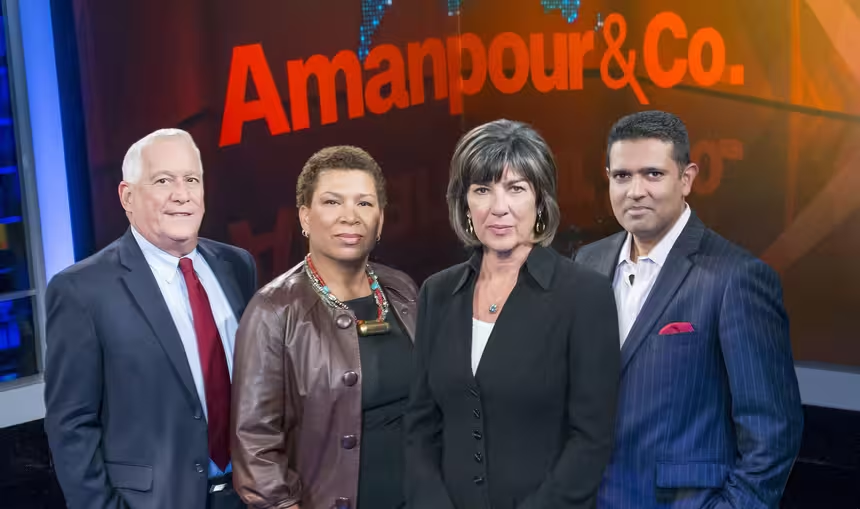
PBS and WNET, in collaboration with CNN, launched Amanpour and Company in September 2018. The series features wide-ranging, in-depth conversations with global thought leaders and cultural influencers on issues impacting the world each day, from politics, business, technology and arts, to science and sports.Providing Support for PBS.org
Learn Moreabout PBS online sponsorshipSo it is the final stretch before the midterms, which are now just days away.
And with the control of the Senate and the House at stake, President Trump has been criss-crossing the country, hosting a flurry of rallies in a bid to secure Republican votes and keep historically red states like Texas in GOP hands.
Between the scandals and Republicans distancing themselves from the U.S.
leader amid low approval ratings, their election campaign has been far from smooth, as New Yorker staff writer Benjamin Wallace-Wells tells Michelle Martin.
Thanks Paula.
Benjamin Wallace-Wells, thanks so much for joining us.
Great to be here.
So we are just days away from the midterm elections as you and I are speaking now.
The control of the Congress is at stake.
You are looking at Republican campaigns across the country for your latest piece in The New Yorker.
You found signs of Republican campaigns that were in trouble in surprising places.
So just what's kind of the overview there?
Give us the through line and then we'll kind of go race by race.
What's been interesting to me, and I began just a couple of weeks ago trying to think through why is it that Republicans are struggling so much in states that they are usually quite comfortable in, where President Trump won in 2024 by 10 points, 11 points, 13 points.
And I started looking closely and going around and seeing the debates and the events that Republican candidates were staging.
And the broad picture, I think, is that many Republicans are finding it quite difficult to defend President Trump's second-term record.
So on top of whatever, you know, line of scrimmage we've drawn across the last 10 years, red versus blue, and whatever penalty a sitting president tends to incur in midterm elections, what we have is in debate after debate, Republican candidates turning away from defending the tariffs, defending the war, defending data centers and the president's relationship with billionaires like Elon Musk.
And there's just, I think, a general discomfort with a lot of what he has done, which I think is telling both in terms of where the party stands for this election, but also what might come next.
Is there anything sort of surprising about this, just simply because the president has had such a heavy hand in picking some of these candidates?
I mean, the fact of the matter is people call it his party now.
It's Trump's party now.
I mean, he is the head of the RNC, you know, for all intents and purposes.
In fact, his daughter-in-law was the head of the RNC earlier.
And another former head of the RNC is running for Senate in North Carolina, Michael Watley, and likely to lose.
I think it's extremely surprising.
And it's not just because of those candidates whose hand picked.
Ken Paxton in Texas is another one.
But because for several cycles, what we've seen is Republican candidates echoing the tone, the kind of bombastic demeanor, but also really defending to the hilt the president's policy positions.
And, you know, this is on tariffs, on immigration and up to and including January 6th.
And, you know, so to see, you know, some break from that, especially when it comes to the to the, you know, questions that have been at the center of his second term agenda, I think is is pretty interesting.
So let's go to North Carolina.
You just mentioned that Trump went there in 2024.
It's handpicked Senate candidate Michael Watley.
He's trailing former Democratic Governor Roy Cooper.
Trump recently actually acknowledged this at the rally.
So why has this race so difficult for Republicans?
What Trump said at that rally, he was speaking of Roy Cooper, and he said he's going to be our next senator.
And that's a little crazy.
And it is at some level a little crazy.
You know, what we're seeing is not just in North Carolina, but in Georgia, you know, Democratic candidates are way out in front.
In South Carolina, there's a competitive race, you know.
And what those Democratic candidates have been able to seize on in those races is the high gas prices.
They've been able to tie that to the war in Iran and the president's indifference, seeming indifference to questions of affordability.
And, you know, Georgia is actually an even more vivid example of this.
They've been able to, you know, say that, you know, the president's relationship with donors and money is corrupt.
You know, John Nassau speaks of a coin-operated, you know, political system.
So there is a willingness of Democratic candidates in those states.
Roy Cooper, the sitting governor of North Carolina, is a candidate in North Carolina.
There's been a willingness of those Democratic candidates to take a kind of more populist position and just say, you know, things have gone way off track in Washington.
They have before, though.
I mean, that's not a hard position for Democrats to take.
And any other party, power party.
I don't know any other party to say, look, this is just ridiculous.
But I guess what's interesting and what's puzzling to people, if every poll to this point, the Republican base has been with the president and people, you know, like I've been out canvassing too, in lots of different places.
You interview people at the pump, right, filling up their cars.
You go, how do you feel about that?
Don't like it?
Feel bad?
Well, do you know why gas prices are so high?
And they can correctly identify the cause of it, which is the state of Hormuz being closed.
To this point, Republicans were still with the president.
They accepted his analysis.
One thing that I find pretty striking and that reinforces that point is if you look at the president's approval rating, February really is a pivot point.
When we started going to war with Iran, even though it's not the most intense war that the United States has ever fought, even though there's not a huge commitment of troops, there's a pretty clear line of about 40% approval that he'd mostly been able to stay above.
He just starts going down, down, down.
And if you look at the timeline, that's basically when these races start to get competitive in places that they hadn't been before.
And so there is something, I think, for ordinary voters that's quite clarifying about war, you know, that makes people see that, you know, here is where the government's commitments lie.
Here's where the president's commitments lie.
And they don't lie, you know, with keeping prices down.
Is it the Republican base starting to soften, have skepticism?
Is it the growing number of people who really prefer to identify themselves as independents?
Where's the disapproval coming from?
I would say it's two areas.
If you look at what the president did in 2024, he brought in a pretty significant number of voters who are outside of the system, who are voting for the first time or were irregular voters.
That population skewed younger, skewed male, skewed Hispanic.
Those voters, Gen Z voters, Hispanic voters, are abandoning him in droves right now.
And this is part of why Texas, for instance, is competitive.
And so one source of that softness is probably that in 2024, some of those voters were just the anti-status quo voters and the status quo was Democratic.
And now they're either sitting this one out or they're still anti-status quo voters.
They don't like what's going on and the status quo is Republican.
And so at some level, I think that is a big part of the story.
But when we look at places like Kansas and Iowa, Kansas has not had a Democrat in the Senate since 1939.
You know, Iowa is a state that the Republicans won by 13 points, you know, just a year, you know, a little more than a year ago, two years ago.
Ohio, where, you know, J.D.
Vance is from, the vice president, where Trump won.
All those states are competitive.
Texas, you know, most of all, all those states are competitive.
And part of what has happened there is just the kind of long-term exhaustion with the president's policies.
If you look at the debates and events, there's still many of the Republican candidates are still trying to channel the sort of topic of the election back towards the culture war to pinpoint Democrats on where they stand on trans athletes in sports, for instance, a big issue in 2024.
But it's not really working.
And the concerns of voters are really economic.
Their pocketbook concerns are about affordability and all of the concern about the straight and form moves and, you know, Elon Musk's influence in politics and the data centers that kind of feeds, you know, quite neatly into that affordability narrative.
So I think independents and sort of more moderate Republicans in red states who, you know, who I think are sort of are feeling the same pressures that all voters are.
We've talked a lot about the president's kind of role in all this and his policies and how these policies are finally starting to hit people.
But aside from that, do the Democrats just have better candidates this year?
Are the Republican candidates worse?
Yeah, I think the Democrats have very good candidates this year.
You know, they are generally young.
They are, in most cases, running from outside of Washington, outside of elective office, in a way that means they don't have to defend the Biden administration's policies, which were quite unpopular.
They've taken the opportunity to sort of put a new face on the party.
And I think in general, they've debated well and campaigned well.
The Republican candidates, I think, are terrible.
You know, there are a couple of places where Trump has sort of forced the party's hand.
I think in Texas, the push for Ken Paxton, who has, you know, really lengthy, you know, corruption allegations against him.
President Trump was dissatisfied with John Cornyn, the incumbent, and he pushed hard for Paxton to be the nominee.
And that may well cost the Republicans the seat.
You know, Mike Collins in Georgia is a messy candidate, a son-in-law who's an open white supremacist.
And John Ossoff has been able to take advantage of that.
But if you look across the board, there are a lot of pretty good Republican candidates who are the candidates that the party establishment, not just the president, wanted.
You know, I would say Ashley Hinson in Iowa, a congresswoman, has been to me quite impressive and quite tactical in how she's tried to sort of maneuver around some of the president's unpopularity.
John Husted, the lieutenant governor in Ohio, is an experienced and, you know, pretty well-liked political figure there.
Michelle Tafoya, a former ESPN reporter, has been to me.
Yeah, sideline reporter.
Yeah, comfortable on TV, colloquial in how she addresses voters, you know, and I thought out-debated Peggy Flanagan in their debates.
And also, to your point, kind of could run apart from Trump because she really was outside of the Washington system.
There was no reason that you wouldn't necessarily tie her to Trump.
Totally, and open that debate by saying there are a lot of places where I'm going to disagree with my president and my party, you know, and branding herself as somewhat different.
It doesn't look like it's going to work.
You know, Minnesota is still a relatively democratic state.
Doesn't look like it's going to work.
But I think that, you know, this is not - there have been elections in the past where, you know, during the Trump - where Trump has hand-picked candidates, you know, Herschel Walker in Georgia, who had no business being U.S.
senators, and that has cost his party.
In this case, I think Paxton might be an example of that.
But by and large, these are pretty solid Republican candidates who are running in reddish states.
That's where the battlegrounds are.
And they have not been able to make an effective case and they're in trouble.
Okay, well, let's talk about Ohio, because you have the nominee for governor, Tibetan Ramaswamy.
He posted this ad with the Democratic candidate's estranged mother, who the candidate has not spoken to since she was 12 years old, because she was, by all accounts and police reports, court documents, affirm this, that she was abused by her stepfather, to whom her mother was married.
The stepfather never faced justice because he fled the state and died out of state.
Okay.
So he posts an ad.
First he denied it was his ad, but then it became clear it was his ad.
With this estranged mother calling the Democratic candidate Dr.
Amy Acton a liar, says she's lied about everything.
Okay.
It's caused a huge uproar.
Many even Republicans have said they are disgusted by this.
Ramaswamy has said it's not really about sexual abuse.
It's about her being a liar.
President Trump, not surprisingly, has doubled down on this, of course, because he never apologizes.
He's made it clear that that's not his ethos at all.
The Vice President, Jaden Vance, has criticized Republicans who criticize the ads calling them whining.
How do you see this whole episode?
I think it's really fascinating.
So yeah, Vivek is, you know, maybe the Trumpiest politician, you know, who ran in that race other than Trump.
When he ran for president, he ran in this sort of like, very aggressive, very bombastic, intentionally divisive way.
He said outrageous things like Trump did to try to polarize the electorate.
And indeed, Ramaswamy went on to co-chair Doge for a time and work in the administration.
So Vivek, to me, who is, you know, quite young in his early 40s, represents, you know, the part of the Republican Party that is that is seeking to, you know, emulate Trump in style and tone.
And in this case, he did a very Trumpy thing, you know, he did something that was extremely eye catching, that was unbelievably aggressive, that, you know, almost courted opposition from the press, you know, and from members of his own party, in order to divide the public and, you know, draw those on his side closer to him.
Vance and Trump, you know, again, the Trumpiest part of the party, said, "This is great."
Trump said that the ad had hit Peter, you know.
Vance, as you said, called on other members of the party to stop whining.
But the rest of the Republican Party in Ohio, including John Husted, who's running for Senate, and has Trump at his rallies praising him again and again, have distanced themselves from the ad.
They said this has gone too far, effectively.
To me, this raises questions about what the tone of the Republican Party is going to be going forward, what the style is, whether this politics of extreme polarization, of courting opposition from the press and from independent authorities, whether that's going to continue to be the MO of Republicans going forward, or whether that's something that's going to be left with Trump.
To be determined, and a lot of us have watched the Republican Party over the last 10 years, and wondered, you know, is this just sui generis?
Is Trump just Trump?
And once he's gone, the party will be different?
Or, you know, are there others who are as effective doing what he does as he does?
I think this is, you know, a sign, a small sign, but a sign that maybe it will have trouble replacing the same kind of formula, you know, with another figure at its head.
I think it is noteworthy that Ramaswamy has decried racism, for example, in the Republican Party, presumably because it's directed at him.
He's South Asian or directed at others like him, but he doesn't seem to have a problem with a) racism directed at other people and, you know, like, for example, the Haitians in Springfield who have been subjected to this aggressive deportation campaign and lies.
I would say that watching all these debates, one thing that is striking to me is that even though Republican candidates by and large are backing away from or being very tentative around the president's policies on tariffs, on Iran, on his entanglements with Musk, immigration is generally not a place where they have stepped away from the president.
And, you know, they, you know, still talk in terms of, you know, the need for strong internal enforcement, of the need for strong borders.
They tend to back, you know, when they're criticized about the president's or they're asked about the president's ICE policies, they might say, "Christy Noem made some mistakes and it's good she's gone."
But in general, they will back the president's approach to immigration.
And my guess would be, in whatever iteration of the Republican Party comes next, that, you know, sort of, you know, hawkish approach to immigration combined with, you know, at least the racialized sort of way of telling stories around who is coming into the country and who should be an American.
I think that's likely to continue to be part of the parties make up for a while.
I don't see a lot of signs that that is abating.
- Benjamin Wallace-Wells, thank you so much for talking with us.
- Benjamin Wallace-It was a pleasure.
Thank you.
 New Episode
- News and Public Affairs

Top journalists deliver compelling original analysis of the hour's headlines.
 New Episode
- News and Public Affairs

Today's top journalists discuss Washington's current political events and public affairs.


 New Episode
 New Episode
 New Episode

 New Episode
 New Episode

 New Episode


Support for PBS provided by: