
U.S. and Iran strikes intensify as war opens new fronts
Clip: 7/30/2026 | 3m 3sVideo has Closed Captions
U.S. and Iran strikes intensify as war opens new fronts
Strikes and counterstrikes between the U.S. and Iran intensified on Thursday, fueling fears the conflict could spread across the entire region. For the first time in five months, suspected military action expanded to Egypt with a drone strike that now marks a new front in the war. William Brangham reports.
Problems playing video? | Closed Captioning Feedback
Problems playing video? | Closed Captioning Feedback
Major corporate funding for the PBS News Hour is provided by BDO, BNSF, Consumer Cellular, American Cruise Lines, and Raymond James. Funding for the PBS NewsHour Weekend is provided by...
U.S. and Iran strikes intensify as war opens new fronts
Clip: 7/30/2026 | 3m 3sVideo has Closed Captions
Strikes and counterstrikes between the U.S. and Iran intensified on Thursday, fueling fears the conflict could spread across the entire region. For the first time in five months, suspected military action expanded to Egypt with a drone strike that now marks a new front in the war. William Brangham reports.
Problems playing video? | Closed Captioning Feedback
Where to Watch PBS News Hour
PBS News Hour is available to stream on pbs.org and the PBS app.
Providing Support for PBS.org
Learn Moreabout PBS online sponsorshipAMNA NAWAZ: Welcome to the "News Hour."
Strikes and counterstrikes between the U.S.
and Iran intensified today, fueling fears the conflict could spread across the entire region.
GEOFF BENNETT: For the first time in five months, suspected military action expanded to Egypt with a drone strike that now marks a new front in the war.
William Brangham starts our coverage.
WILLIAM BRANGHAM: Today, a declaration that the war has now spread to the Mediterranean, Egypt confirming that a drone caused yesterday's massive fire that engulfed two natural gas vessels.
It struck Damietta Port on Egypt's northern coast, about 30 miles from where the Suez Canal meets the Mediterranean Sea.
One of those ships was American-owned.
Egyptian officials said no party claimed responsibility for the attack, but, tonight, Iran's foreign minister blamed the attack on -- quote -- "Israeli plots."
It comes as the U.S.
and Iran exchanged barrages overnight, a brief pause in fighting up in flames and a pattern of back-and-forth strikes reignited.
The Iranian military said it destroyed three American F-35s at an air base in Jordan, though the U.S.
military denied that.
Jordan said it intercepted at least five Iranian missiles.
That all came after what U.S.
Central Command called a heavy wave of U.S.
airstrikes targeting Iran's military command centers, weapons facilities, and coastal surveillance sites.
Iranian state media said at least three people were killed in an explosion on Qeshm Island off Iran's Gulf Coast.
Some residents in Tehran called on their government to respond with even more force.
AMIR, Tehran, Iran, Resident (through translator): Iran should take the initiative.
We're always waiting for them to attack first and then for us to attack.
MILAD KESHAVARZ, Tehran, Iran, Resident (through translator): In my opinion, America's aim is to weaken the Islamic Republic system and break the Axis of resistance in the region.
WILLIAM BRANGHAM: Hopes for a quick end to the war, now past the five-month mark, are increasingly dim.
And diplomats, including key mediators from Pakistan, fear it could escalate even further.
TAHIR ANDRABI, Spokesperson, Pakistani Ministry of Foreign Affairs: We note with concern the security situation -- that the security situation remains precarious, despite the relative calm of last few days.
The negotiations between the parties are ongoing to normalize the situation, particularly the situation in the Strait of Hormuz.
WILLIAM BRANGHAM: The embattled Strait of Hormuz is now one of three major shipping choke points threatened by this conflict.
This week, Houthi rebels attacked ships in the Bab al-Mandab, the gateway to the Red Sea, and the drone strike in Egypt puts the Suez Canal at similar risk, all while the conflict continues to wreak havoc on the global economy.
For the "PBS News Hour," I'm William Brangham.
Blanche vote on hold over anti-weaponization fund opposition
Video has Closed Captions
Blanche's AG nomination on hold over opposition to DOJ's 'anti-weaponization fund' (5m 55s)

Breaking down the GDP report as U.S. economy slows
Video has Closed Captions
Breaking down the GDP report as U.S. economy slows in 2nd quarter (7m 32s)

How music has helped tell America's story
Video has Closed Captions
How music has helped tell America's story from the very beginning (4m 48s)
How shipping risks from Ukraine and Iran wars are converging
Video has Closed Captions
How shipping risks from Ukraine and Iran wars are converging (6m 26s)

Missouri couple murdered in Guatemala after deportation
Video has Closed Captions
Missouri couple murdered in Guatemala after husband was deported (6m 22s)
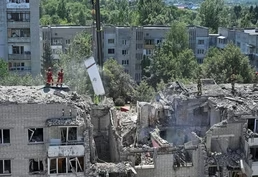
News Wrap: Russian drone, missile attack kills 10 in Ukraine
Video has Closed Captions
News Wrap: Russian drone and missile attack kills 10 in Ukraine (5m 25s)
Scholars urge Congress to adopt proportional representation
Video has Closed Captions
Group urges Congress to adopt proportional representation to end redistricting battles (6m 21s)
Violence surges in West Bank as settlers escalate attacks
Video has Closed Captions
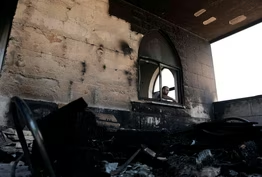
Violence surges in West Bank as Israeli settlers escalate attacks on Palestinians (6m 43s)
Providing Support for PBS.org
Learn Moreabout PBS online sponsorship New Episode
- News and Public Affairs

Today's top journalists discuss Washington's current political events and public affairs.

- News and Public Affairs

FRONTLINE is investigative journalism that questions, explains and changes our world.

 New Episode
 New Episode
 New Episode
 New Episode
 New Episode
 New Episode
 New Episode
 New Episode
 New Episode
Support for PBS provided by:
Major corporate funding for the PBS News Hour is provided by BDO, BNSF, Consumer Cellular, American Cruise Lines, and Raymond James. Funding for the PBS NewsHour Weekend is provided by...