
Ukraine faces military desertions as Russian war grinds on
Clip: 4/9/2026 | 8m 41sVideo has Closed Captions
Ukraine faces military desertions as Russian invasion grinds through 5th year
Ukraine’s military is facing a growing problem of desertion. An estimated 150,000 service members may be missing from their units as the war grinds through its fifth year. Soldiers cite fatigue caused by long deployments, anger at orders seen as suicide missions and forced mobilization. Special correspondent Jack Hewson reports on one young soldier who says he was pushed beyond his breaking point.
Problems playing video? | Closed Captioning Feedback
Problems playing video? | Closed Captioning Feedback
Major corporate funding for the PBS News Hour is provided by BDO, BNSF, Consumer Cellular, American Cruise Lines, and Raymond James. Funding for the PBS NewsHour Weekend is provided by...
Ukraine faces military desertions as Russian war grinds on
Clip: 4/9/2026 | 8m 41sVideo has Closed Captions
Ukraine’s military is facing a growing problem of desertion. An estimated 150,000 service members may be missing from their units as the war grinds through its fifth year. Soldiers cite fatigue caused by long deployments, anger at orders seen as suicide missions and forced mobilization. Special correspondent Jack Hewson reports on one young soldier who says he was pushed beyond his breaking point.
Problems playing video? | Closed Captioning Feedback
How to Watch PBS News Hour
PBS News Hour is available to stream on pbs.org and the free PBS App, available on iPhone, Apple TV, Android TV, Android smartphones, Amazon Fire TV, Amazon Fire Tablet, Roku, Samsung Smart TV, and Vizio.
Providing Support for PBS.org
Learn Moreabout PBS online sponsorshipUkraine's military says it's facing a growing problem of desertion.
Experts estimate approximately 150,000 service members may be missing from their units as the war grinds through its fifth year.
Soldiers site extreme fatigue caused by long deployments without rotation, anger at orders seen as suicide missions and forced mobilization.
Special correspondent Jack Houston reports on one young soldier who says these pressures pushed him beyond his breaking point.
We've changed the names and voices of some of the subjects in this report to protect their identities.
Across Ukraine's towns and villages, tens of thousands of former soldiers hide from a duty they can no longer face.
For many, like Andre, it wasn't always this way.
He signed up to fight willingly in 2023.
I couldn't just sit there healthy and young and not go defend my country.
I thought there was something to fight for.
When Andre arrived at the front in Bakma in eastern Ukraine, he was just 18 years old.
But his youthful enthusiasm to defend his country quickly turned.
At first, he was sheltered from frontline missions.
According to his comrade, Sasha.
He was the youngest among us.
To be honest, he was like a child.
He didn't understand where he had come from.
He was a little confused.
As he became an accomplished fighter, Andre's youthful enthusiasm and patriotic zeal would be tainted by his perception of the battalion's leadership.
I thought people would be valued.
I thought there would be some kind of support there.
Well, I got there and I realized that the commanders were sending people to their deaths.
It was crazy.
It was his allegedly flippant attitude towards life and the pressures of the command that he believes led to the suicide of a friend, Dennis Boy, a frontline position in early 2024.
I went into the kitchen and saw the soldier lying there, his head gone.
I just saw that and froze.
I just stared at him and that was it.
I couldn't even understand anything.
I just stared at him, his head gone.
It was just crazy.
Boy recorded his suicide on the eve of a dangerous assault mission he didn't want to complete.
He filmed a suicide note on his phone before shooting himself in the head with his assault rifle on camera.
The man couldn't take the pressure because the commander put a lot of pressure on him.
The man shot himself and he was only 20 years old.
Chief Sergeant Vladimir Tach was also present at the time.
He agreed with Andre that boy had been pressured, but he said other factors were also in play.
He had a fight over his girlfriend, a little alcohol, a little unprofessional work by a psychologist with him the day before and plus the pressure from the command.
And this young man simply couldn't cope.
Deeply traumatized by the incident, Andre's mental health would deteriorate over 2024 as he was sent on ever more dangerous missions, often stranded on the hard front without adequate ammunition or even food and water.
They fried snakes there and ate them.
I drank water from puddles through a straw.
I wanted to drink so badly.
What would soon prompt Andrew's desertion were a series of catastrophic missions in Krna in 2024. missions he says convinced him he could no longer trust his commanders.
We have a battalion.
We just entered Cresno Harifka in 2024 and our battalion was immediately bombed.
Everything it was just awful what was happening.
Just a few people survived.
One soldier next to me is suffocating.
The other has no legs.
The commander says, "Evacuation will be in a couple of days."
He says, "Well, that's how it is."
He says, "You can't do anything.
Just endure it."
I'm in shock.
I'm sitting there thinking, "What's going on?
Lucky to survive that bombardment, Andrew would eventually be wounded in a drone attack.
After only a few days in hospital, he returned to the front where his commanding officer told him he would be deployed on an assault mission the following day.
This was his breaking point.
He said, "You're going to storm the building."
I say, "No, that's it.
I'm done."
I say, "I endured two and a half years, endured, endured, endured, and now I say you're a scumbag.
Will you come with me?"
He said, "No, that's it."
Then the sergeant took my machine gun because I wanted to shoot him.
Our commander, they took my machine gun away from me.
The commander just said, "If you are killed, it doesn't matter.
I will send new soldiers.
He's not a commander.
He's just a monster."
The commander Andre is referring to is Major Alexi Cuchareno.
Andre's comrade, Sasha, also complained that Cucherenko's decisions had repeatedly cost lives and almost cost him his own.
After returning from one mission, having lost men, he said, "Major Couturenko merely mocked them."
He said, "Guys, you fought badly.
Not many of you died.
Couldn't you fight better?
No.
Then we'll replace you and send you to even deeper places."
Chief Sergeant also identified Major Cucherenko as a factor in Andre's eventual desertion, but said he was symptomatic of a broader failure.
I can name Major Cucheno, the battalion commander at the time, but I emphasize this is a systemic problem.
I must say that Major Cucheno's fault, in my opinion, lies in his incompetence and in supporting this system that doesn't work.
If you talk to Major Cooeno, he will say that he is a great guy and the company commander is a fool.
Sorry for being frank.
Well, and so on.
The company commander will say that he is a great guy and that it is the sergeant who gave the order etc.
Amid the grim brutality of the front throughout last year, Ukraine saw a sharp rise in soldiers deserting.
Thousands have walked off of the front line.
Soldiers and some commanders describe exhausted infantry units collapsing rotations, forced conscription, and resentment at leadership failures.
If in 2022 2023 we had one or two maximum three people in the unit who became deserters then since 2024 there have been tens of thousands across the country and this means that this is a systemic problem.
Why is it now that the numbers are escalating so quickly with regards to desertion?
The reason is again very simple mobilization how it is carried out.
The catch is referring to the forced mobilization that has sent thousands of men in some cases literally pulled off of the streets into mini buses, a phenomenon dryly referred to as busification and then shipped on to the front.
And when human rights are violated, you should not expect that this person will become a super patriotic hero.
Shortly after our interview with Andre, we discovered that he'd been arrested by military police and despite his debilitating PTSD, was being forced back to frontline duty.
He managed to talk to us briefly over video call at a detention center in Nepro.
There are people like me here.
They were deserters and they were also caught.
Some were caught by military registration office employees and brought here.
I don't know what they're doing here.
I am very angry, very angry.
They don't want to send me for treatment.
I tell them I have torn ligaments in my body and a traumatic brain injury.
My eardrums are ruptured.
I have shrapnel inside me.
And they say, "You'll come to the battalion like this and only then will we decide what to do.
People here treat me badly."
Before we could continue our interview further, Andrew was forced to stop filming by the guards at the detention center.
He was taken back to the front line a few days later.
Within weeks, we learned he had deserted once again.
Responding to the allegations made in this report in a written statement, the Ukrainian Ministry of Defense said that any instances of misconduct were categorically unacceptable and had no place in their ranks.
Additionally, they stated that the fact should be reported for legal assessment and if confirmed, appropriate disciplinary action should be taken.
We made multiple requests for comment from the command of the 21st special purposes battalion and from Major Couturenko but received no response.
Despite the injustices described by soldiers in this report all stressed their pride in their service and in their national cause.
But forcing men to fight against their will is compounding desertion numbers and degrading morale.
For the PBS NewsHour, I'm Jack Houston in Ukraine.
Support journalism you trust.
Support PBS News.
Donate now or even better, start a monthly contribution today.
 New
NewAnthropic’s new AI model raises fears about high-tech risks
Video has Closed Captions
Anthropic’s powerful new AI model raises concerns about high-tech risks (6m 19s)
 New
NewInside Chicago's Steppenwolf Theatre as it marks 50 years
Video has Closed Captions
Inside Chicago's innovative Steppenwolf Theatre Company as it marks 50 years (6m 39s)
 New
NewIsraelis mark Passover in shadow of war
Video has Closed Captions
Israelis mark Passover in shadow of war: 'We cannot celebrate together' (5m 10s)
 New
NewIsrael, Lebanon to talk as strikes threaten U.S.-Iran truce
Video has Closed Captions
Israel agrees to talks with Lebanon as strikes there threaten fragile U.S.-Iran truce (6m 58s)
 New
NewMelania Trump denies close relationship with Epstein
Video has Closed Captions
In rare public address, Melania Trump denies close relationship with Epstein (2m 31s)
 New
NewNews Wrap: NASA optimistic ahead of Artemis II reentry
Video has Closed Captions
News Wrap: NASA optimistic ahead of Artemis II reentry (5m 28s)
 New
NewTrump’s Iran rhetoric faces scrutiny as Congress returns
Video has Closed Captions
Trump’s Iran strategy and rhetoric face scrutiny as Congress returns from recess (5m)
 New
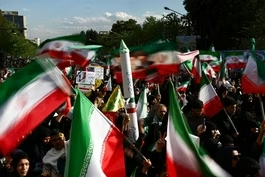
NewWhat Iranians are saying about the war and their government
Video has Closed Captions
What people in Iran are saying about the war and their government (5m 23s)
Providing Support for PBS.org
Learn Moreabout PBS online sponsorship
- News and Public Affairs

FRONTLINE is investigative journalism that questions, explains and changes our world.

- News and Public Affairs

Today's top journalists discuss Washington's current political events and public affairs.












Support for PBS provided by:
Major corporate funding for the PBS News Hour is provided by BDO, BNSF, Consumer Cellular, American Cruise Lines, and Raymond James. Funding for the PBS NewsHour Weekend is provided by...