Write Around the Corner
Write Around the Corner: Edith-Anne Duncan
Season 8 Episode 8 | 26m 43sVideo has Closed Captions
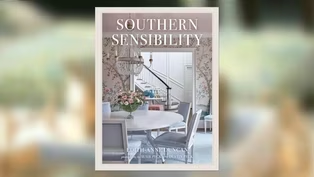
The book, Southern Sensibility, gives insights into creating a beautiful and functional home.
Edith-Anne Duncan shares insights into creating a beautiful and functional home as we discuss her book, Southern Sensibility.
Problems playing video? | Closed Captioning Feedback
Problems playing video? | Closed Captioning Feedback
Write Around the Corner is a local public television program presented by Blue Ridge/Appalachia VA
Write Around the Corner
Write Around the Corner: Edith-Anne Duncan
Season 8 Episode 8 | 26m 43sVideo has Closed Captions
Edith-Anne Duncan shares insights into creating a beautiful and functional home as we discuss her book, Southern Sensibility.
Problems playing video? | Closed Captioning Feedback
How to Watch Write Around the Corner
Write Around the Corner is available to stream on pbs.org and the free PBS App, available on iPhone, Apple TV, Android TV, Android smartphones, Amazon Fire TV, Amazon Fire Tablet, Roku, Samsung Smart TV, LG TV, and Vizio.
Providing Support for PBS.org
Learn Moreabout PBS online sponsorship-[woman VO] This program is brought to you by the generous support of the Secular Society, advancing the interests of women in the arts in Virginia and beyond.
♪♪ ♪ Every day (every day) ♪ ♪ Every day ♪ ♪ Every day I write the book ♪ ♪♪ -Welcome, I'm Rose Martin, and we are Write Around the Corner in Blacksburg, Virginia, with nationally recognized interior designer, Edith-Anne Duncan.
Her book, Southern Sensibility , focuses on a sophisticated but casual approach to today's lifestyle.
This is going to be a great show, and we're going to learn so much.
Let's meet her.
Hi, Edith-Anne.
-Hi there, nice to see you.
-It's so nice to see you, and this place is gorgeous.
-Thank you so much.
We really enjoyed it.
And so, for our viewers, where are we?
-We are in Blacksburg, Virginia, of course the home of the Virginia Tech Hokies, and a wonderful area to raise children, family, retire, everything.
-But better than that, it's your home.
-It is.
-Yes.
Absolutely.
We built this home, we've been here nine years, so it's custom, and it's very livable and approachable and comfortable.
And that's one thing that guests always say, or friends when they come over, how comfortable they feel here.
-[Rose] Well, and I think that's true when you come into a home, you immediately get a feeling you know.
And let's look at this sweet puppy on your lap.
So it's dog-friendly.
-Absolutely.
-What you'd think, "Oh, how do you do an interior design or do things like that that are dog-friendly?"
But before we get to all that, let's go back to Edith-Anne as a young girl, and loving to decorate and redecorate?
-Yes.
So as a child, I would always move the furniture in our home, in my bedroom, living room, and then I also wanted to be an architect.
And my science and math wasn't very good.
So I went another route and chose the interior design path, loved it ever since.
As a child I loved playing with doll houses, and during high school, I would sketch and do drafting.
My mother even asked if there was a cute guy in the class, because Edith-Anne, "Why are you taking drafting?"
And I said, "Mom, I would like to learn how to draft," and you know.
So it just, it led from there.
-Well, and I love the story about the Lincoln Logs.
-Yes.
-And the fact that, "oh, you're going to work with Lincoln Logs and doll houses."
What's the story?
-Yes, the story is, I love to make rugs, wallpaper, artwork, move furniture and the Lincoln Logs themselves.
So I love taking those apart, building them, creating spaces.
And then my best friend growing up, her name was Dawn, and she had, it was literally a replica of her home, white Georgian.
She had a little drawer that you pulled out, and you pushed the little switches and all the lights chandeliers would come on and off.
Beautiful, it was amazing.
I needed that doll house.
-Right.
Did you get one?
-No.
Eventually.
But I did create one last year as a fundraiser for the Montgomery County Christmas store that we actually furnished and auctioned it off and had a great fundraiser with that as well.
So it's kind of come back you know... -Years later.
-and circle later, yes.
-Years later.
-Yes.
-All right.
So you took the drafting class.
But then there's little things that really kind of set you apart.
And I love the fact that there's not a monogram that you haven't met that you don't love.
-That's correct.
-[Rose] So monograms belong anywhere?
-Anywhere and everywhere.
Anywhere and everywhere.
It could be bedding, jewelry, pillows, trays.
We'll talk about trays I guess a little bit later too.
I have my own little formulas for things.
But yes, definitely monograms.
-So this design fascination, do you think it was a gift that erupted from early times, your family members, or is it something you learned?
-I really do think it's something that you grow up with too.
So both of my grandmothers and my father had a flair for design.
And so I also grew up in a beautiful childhood home with my mom and dad and then my grandmother as well, with actually both of them.
And one was professionally done.
So I think that teaches you a lot about scale and proportion and how to mix patterns and colors.
So yes I do think if you're around those items, then you absorb it more than you think.
But you also need to have the education behind it.
So I actually taught a little bit adjunct at Radford University as well in interior design.
And you could tell that some of those students didn't grow up in that.
But they have a knack for it.
So it is something that you may learn.
But if you grow up in it, I think that helps you even more.
-So someone has a desire.
It's possible you put in the hard work, it can happen.
But for like anything else, sometimes it's easier if you're naturally inclined.
-Correct.
-Okay.
That makes sense.
So you've also had some experience at High Point and you were there.
What kind of things went into creating you know, this nationally recognized designer and your own business now that led you to this point?
-So I think what really helped me at the High Point University was I was a triple major.
And they're the home furnishings capital of the world, High Point is.
So I was a home furnishings marketing major.
So they actually taught us you know, how is this piece of furniture made, what are the components that went into it, how is it assembled, and how do you sell it?
So that was one portion.
And then I was also a business major.
So you know, accounting.
Learned all of those aspects.
And then interior design.
Now I will say that High Point University at the time was more decoration.
And they taught us how to mix fabrics, colors, where my master's degree from Virginia Tech was more technical.
And so that was a great mix because the components that I learned at Virginia Tech really complemented what I was missing at High Point University.
So more decoration and the very technical.
So my whole philosophy is something has to function first and then it needs to be attractive.
So there's a science into everything that I do in placement of furniture spaces.
Again, it has to function first and then be aesthetically pleasing.
-So it's much more involved because people oftentimes get an interior decorator and an interior designer thinking they're the same, but they're not.
-They're not.
And I tell you in the very beginning when I first received my degree because it was very difficult and very hard and especially your master's degree.
You know, you're very proud of the time and effort that you put into this.
So I was very irritated sometimes when they would call me an interior decorator because you can call yourself an interior designer if you have an education.
But now over time you know, I've sort of let that go.
And if someone calls me an interior decorator, it's okay because that's an aspect that people understand.
But there is a difference, so.
-And what about the influence?
I was watching one of your videos that you did with your mom.
And you're like, "As a southern girl, we make sure to always wear lipstick."
-Yes, absolutely.
-So what are some of the other fun things that you know kind of create Edith-Anne?
I know the glasses are one.
And so what are the other kind of things that you think, you know in your design work, in what you want to bring to even you and your comfort level?
How did that all evolve?
-I really... I was taught from my mother to always use items every day and not save the best for just special occasions.
Every day is a special occasion.
You need to live for today.
-So if you've got Christmas plates out there, everybody get them out during the holidays.
-Get them out, absolutely.
-And that sterling silver, use it every day.
Absolutely.
So and then use items, say a mint julep cup that you've inherited from your grandmother.
Use that to hold cosmetic swabs in your bathroom.
Don't just put it in a cabinet and look at it behind the glass.
Really use those items.
So everything that you touch every day is special and you're enjoying the moment.
Could it even be a cup of coffee?
Have a beautiful tray out with an heirloom cup that you've inherited with some spoons, wonderful linen napkins, and just enjoy the moment.
Take time for yourself and your family.
-And I love that because it's not only beautiful, but you brought up functional first.
-Yes.
-I watched one of your videos and now we can talk about the trays.
Because you're like, "Hey, everybody's got clutter.
Everybody's got stuff."
So how do you recommend that people kind of gather their stuff and still make it look kind of designer-like?
-Yes.
So it corrals those items.
For instance, you have a lot of clutter on the kitchen counter.
You have your salt and pepper, your spatulas.
So corral all of those pieces together on a tray.
Keeps it more orderly.
And it's just controlled, right?
Or if you have a collection of something, a collection, let's say of boxes, group them all together so it's more impactful as a collection versus scattered all over your home.
You can really appreciate it and look at it yourself of that collection.
And then when others come to visit you, then you can talk about those collections.
Maybe it's matchbooks from travels.
So then that's a little conversation starter and a tray or a dish that you can talk about those items.
So we don't always have to go out and buy new stuff.
-No.
So if you've got stuff, I saw the one time you said someone had beautiful collection of milk glass.
Put your pens and pencils or do other things with it.
So advice to people to look around your own house first.
-That's right.
-And see what's there.
-That's right.
And corral them together.
It's more impactful.
-And you also have a rule of three.
What does that mean?
-So what that means is it's almost a triangle of sorts that your eye goes to.
It goes from the top to the side to the bottom.
So an odd number.
So three, five.
So let's say you have three picture frames.
So place a larger one in the back, medium in the front, and then a smaller one to the left.
So make sure your eye move in that triangle.
-But you also have that philosophy with colors.
-I do.
So what I always like to do is start with a statement fabric and then pull the dominant color out of that fabric.
And then there's a secondary color.
So I play with those two colors in one room.
And then so let's say... the secondary color was yellow.
Then the next room, I will make that the primary color.
So the primary room next to it is yellow with a little bit of an accent of the previous room.
So then there's always a continuous thread through our projects too.
So it's not very jarring at all.
It just kind of flows.
That's what makes it easy and easy for the eye to move.
-So for the average person at home, if they're thinking about I love this rug or I love this pillow, the way we make it cohesive from room to room is working with that palette of color.
So making sure they're repeated?
-Yes.
-So how do you get away from being too matchy-matchy so that it all goes well and compliments each other?
-I think that's where you bring in the pattern play, where it's a statement fabric.
And then you place a smaller geometric stripe so it's the pattern play within those pieces too.
-And that's scary for a lot of people.
-It is.
Mixing patterns because you think, "Okay, I'm going to do everything solid and then maybe one other color."
-But there's a science to it.
And it's easy once you get the three basics floral, geometric, stripe or floral, geometric little plaid, or solid.
-And you make it sound easy, but I think what I'm hearing you say too is don't be afraid.
-Don't be afraid.
-Don't be afraid of color.
Don't be afraid to try it.
If it's something you love, figure out a way to make it work.
-That's right.
And I think the reason why I'm not afraid of color is because I grew up in a very colorful home.
And my grandmother would always take me to Pawleys Island, South Carolina as a child and we would go to the cricket shop to go buy new Lilly Pulitzer shift dresses, right?
So Lilly Pulitzer is very well-known for prints and color and trim.
So I think that's where I was just very comfortable wearing those pieces.
So then that's what gravitates me to exploring it more in interiors.
And again our homes were beautiful and colorful.
And I remember those things.
And the great Carleton Varney, you know the famous designer, okay?
Mother and I saw him a few years ago, and I'll never forget this.
He said, "I want all of you to close your eyes, and envision what your childhood bedroom looks like."
-Mm-hmm.
-He goes, "I guarantee your taste, your personal taste today is what that bedroom looks like."
And he's right.
-Oh.
-He really is.
So that just hit me on the head just square.
It was perfect, so true.
-And that's interesting.
So when someone contacts you or you have a new client, and I think people would like to know, so, it can be an individual client.
It can be you know, a big conglomerate of people who need several things done.
What's the very first thing that you do when you get that phone call and someone's like, "Edith-Anne, I need some help.
"But I think I'd like to see if we're a match.
Because I know everyone's not always a match."
-That is correct.
So we go through an interview process.
They interview me, I interview them.
And then we decide if we would like to proceed.
But the first thing we always ask is time frame.
Is it really feasible?
Is it going to really take that short amount of time?
So what are the expectations?
And then budget.
I know it's a bad word, but we have to-- it's the word in the room, we have to know the budget.
So that's really how we start the conversation.
And if the timing is good for our firm and with their schedule.
-Is it true that you like to look in people's closets?
-It is true.
-Okay.
-It is true.
So my science behind that is whatever you're wearing, that's what you feel comfortable in.
So I always ask to go to their closet and I'll say bring out your five best outfits that you just feel phenomenal in.
And that tells me if they like pattern, color, if they're tailored, a little bit more loose and relaxed.
If they're monochromatic with texture, it tells me a tremendous amount.
Because what you wear is reflected in your home.
So think about that.
-That's interesting.
Is it also true outside of the person that you look around and see like the things they might really like?
And then what things they want to make sure they keep and what things are like, "I don't care if you change this."
-I am not that designer that literally wants an entirely clean palette.
I love to incorporate pieces that they love and use those in the spaces.
Perhaps they're positioned differently.
But I love a collection or pieces that they already have and really incorporate that and reuse it in some manner.
-So your kind of philosophy, classic, colorful, sophisticated, casual.
I'm using the words that I think describe you.
Approachable, inviting, and you don't want something to look brand-new.
You want it to look like people have enjoyed that space.
-Absolutely.
If not, it's not going to be inviting.
-Pets, for example.
There are performance fabrics.
There are things you can do with pets that you don't have to make it look -- -Or some adults.
-Yeah, you're right.
Yeah.
Some adults who like to, "Yeah, do that."
People should know that, that depending on their lifestyle what they like to do or who lives in that house with them, you can make it work with them.
-That is our philosophy.
All of our fabrics are performance fabrics or they're treated on site.
We want it to be livable and comfortable.
And if you spill wine or you spill grape juice on it, it's going to clean up and it's going to be fine.
You have to live for today.
-And I think people would love to hear that because they might be afraid of doing that to where, "Oh, we can't sit on that, you know."
-No, no.
Or the years past of having plastic covers -Oh, right.
-on the furniture.
-Yes, yes.
-Right?
And so with your business, do you have to have a whole house or a room?
Or do you have to hire you to come for a whole day?
Because you've got other options for people too.
-Yes.
So we have three options.
The first one is it's a 50-minute conversation.
And that's on a Zoom or a FaceTime.
And you may ask me anything.
"Edith-Anne, I have this paint color "and this wallpaper.
"Is this okay for my dining room?"
And we will walk through and I will tell you all the tips of what size rug, what artwork, whatever you would like to ask me.
"Edith-Anne I'm having 12 for Thanksgiving, what should I do?
You can ask me anything for 50 minutes, okay?
So that's the first one.
The second one is a design in a day.
So we actually had one of those yesterday.
It was a family in Tuscaloosa, Alabama.
And they gave me the dimensions of their family room and they gave me a list of what they like, what they don't like.
And then I asked them what activities they do.
And so I dedicate the entire day literally to map out that entire room, give them all the specifics of the furniture, the rugs, lighting, everything, paint color.
And then we send them a package of sorts.
And they may purchase those items as they would like.
-So people can kind of do a combo DIY thing if they want to do it.
-Correct.
And then you also have collaborations that you work with designing your own kinds of things.
-Yes.
-What's in your portfolio of Edith-Anne designs?
-So a lot of our projects we have custom rugs.
And so I've come up with patterns and combinations that I adore.
And I think more of the mass market would like to see those items.
So I've come up with a collection with KES Collections.
So we have a grouping of rugs that are phenomenal.
And then I also just came out with a mahjong rug with birdsong mahjong.
It's a, excuse me, a mat.
-I saw that on the video.
It was really fun.
-Yes.
-And one of the things else I loved was I watched one of your videos where you took, you went through HomeGoods.
And it was so fun to see you going through HomeGoods and saying, "This frame, yes.
This, no."
Like, I never knew.
Okay.
And if you want to get a pillow from HomeGoods, look at this trim around the edge.
-Yes.
You know so these helpful tips are so fun and accessible for the person who's sitting at home thinking, "I want to do something.
I think I want to try this."
And what I'm hearing you say is, -don't be afraid.
-Don't be afraid.
And you can also mix high and low.
That's another thing.
When you're working with a designer, it doesn't always have to be expensive.
We mix in items from HomeGoods, Target, in multiple places.
It could be your local YMCA thrift store.
We really like to mix.
It does not have to all be expensive.
And then another exciting collaboration I have coming out is with a home, it's a Homeline, home collection.
-Oh, how fun.
-So duvet covers, pillows, other items.
I'm very excited about that, too.
Nice.
-Well, you have an incredible attention to detail.
I think you described yourself as meticulous, right?
Attention to detail.
And I think having design be functional and beautiful and what you talked about, the trays, how you can make that look beautiful and like people would not think, "I can make my clutter look good," but you can.
-You can, yes.
-You can make that look good.
-Yes, yes.
-How do you know when to stop?
Like you know you want to add and layer and add and layer and you think, "Oh, maybe I just need to have one more thing."
Then how do you know when to say, "That's enough, maybe I take one away."
-It's kind of like Coco Chanel, right?
Take off one piece.
-Yeah.
And what I always like to do too is take all of the contents out of a room and then place other items back or move it around.
You don't have to buy new.
Just reposition.
Go in another room and pull something from that room into the other and make it fresh in your eyes and you didn't have to really purchase anything.
Just reposition and just move it around until it's just enough and then stop.
-That's a good tip.
And I think a lot of people will maybe try that, looking at your own space.
Right?
So your book is beautiful.
-Thank you.
-The cover... every part of this book.
And this was a dream, right?
-It was a dream.
So it all started with my first goal was to be on a national cover of a magazine.
-And congratulations on those covers.
-Thank you.
-So I've made that.
So I thought, "Okay, what's the next-- what's my next goal?"
And I said, "Okay, let's do a book."
So I learned the whole process of that, of pitching the book, going to different publications.
So I went with Gibbs Smith and they were fabulous to work with.
And this book contains nine chapters.
Each chapter is a home that we've renovated or new construction.
And there are seven out of the nine are located in Virginia too, which is nice to highlight some residential projects in Virginia.
- [Rose] What I love is the chapter.
There's a chapter called Harmony.
And then you tell us, "Oh, if we think about the word harmony, oh, that means balance, repetition and scale."
So in one side of, when you open up a chapter, there's like a beautiful watercolor painting, and then the book.
How did you kind of figure out who got to be in the book, what pictures, and then what topics?
Because this world of design that you spent your life in is so big it would be multiple volumes.
So how did you pick which things became a chapter?
-It was very tough.
I chose my nine favorite projects of all time.
And I worked with Dustin and Susie Peck, which are lovely photographers from Charlotte, North Carolina.
And I've used them for a long time.
So again that makes all of the photography very consistent, which is very important.
And then you mentioned the watercolors.
So when I walk into a room, I can already see and envision in my head what that space could be.
-[Rose] Really?
-[Edith-Anne] Not all the detail but almost.
-[Rose] I got to stop there.
So you can walk into space, and I know you said at some point in time you have an innate ability to tell size and dimension of things which I can't even get my head around, something like that.
But in addition to that, you can actually see-- -Yes.
I can see what the room can be, yes.
So when I walk into a space, I can envision in myself, "Okay, I would place two surfaces here, "coffee table, chair, overscaled artwork, mirrored wall."
I can envision it in myself, okay?
So what I like to do is... then I get into the details, and that's what I'm known for.
So the watercolor aspect of the book was inspired by Mark Hampton.
So in high school and college, I adored Mark Hampton as an interior designer.
And he always had these wonderful watercolors, illustrations of his rooms that he had decorated.
So I took the inspiration from that to do each chapter lead-in page.
So it's kind of a mood and a wash of what the room and space will be, and then it's clear and nice clarity on the next page with the graphic or the photograph of that project.
-And there's something interesting that I think you are also known for, besides your beautiful color, texture, putting things together.
And you call it the fifth wall.
And what is the fifth wall?
-So the fifth wall is the ceiling.
Everyone forgets the ceiling, and it's just as important, right?
So when you-- -[Rose] I don't know, a lot of us do.
I'm in the forget the ceiling part.
So tell us about it.
-Okay.
So it draws your eye up.
It could be a reflection.
So think of candlelight.
If you're in the dining room, and the wonderful reflection of a very glossy ceiling.
Or perhaps you need to add some character or bones to a room.
So you could add some millwork to the ceiling and add an architectural interest.
All types of things.
You can either highlight it or make it kind of disappear, but it can't be forgotten.
It still needs to be acknowledged.
-[Rose] And you even wallpaper ceilings, right?
- Absolutely.
-And the wallpaper ceilings.
-[Edith-Anne] For that, yes.
And it could be very graphic.
Perhaps that's the charge in the room.
It really just depends on what that moment is, and the mood for that room.
-How do you feel about themed rooms or themed stuff happening in a house?
-No.
Absolutely not.
-No.
Absolutely not.
No.
-So how would people incorporate, you know.
-It's so dated.
It dates you immediately.
If you're going to do with something trendy.
Let's say all roosters or what's another one.
Barn doors or those writing, handwriten signs.
-Yes.
-Signs and stuff.
No, it dates you.
Just go classic.
And it's just timeless and effortless and just timeless.
-And so if people want to edit, to think what could we do right now, right?
They could edit their room.
It would be take away stuff that I'm hearing you say, the stuff that really you don't love to begin with.
That would be the first edit.
And what would you say about the second one?
I would say look at your lamp shades and pillows.
Perhaps just freshening fresh pillows, throws, add in some fresh books for color.
It's really... it's little touches that make all the difference in the world.
-And collecting your clutter.
-Yes.
And that's the one thing, too.
You may buy a piece on a trip, and you don't know where it's going to land.
You will eventually find a place for it.
So buy what you love, and eventually it will find its home.
-I love that.
Because sometimes we're hesitant, aren't we?
Because we love something, and we're like, "I don't know where it's going to go yet.
"I haven't figured out where it goes because my stuff is already full."
So then in your own head, you're thinking, "Well, I can't possibly move anything to do that."
So your house is kind of your laboratory, isn't it?
-It is.
So I've created all types of upholstered doors.
I learned how to do that here before I tried it on a client, or painted floors.
You know I've had experiences with those.
So we are definitely the lab here at home.
And then I will try it if it's successful on a client.
-And how about your husband and twins?
Your twins are grown now, but are they designers at all?
[indistinct] -Yes.
-So our son is in architecture.
So he's getting his master's there at UVA in architecture.
So he's into it.
And then our daughter is a gemologist, graduate gemologist.
So she's jewelry design, appraisals.
She loves estate pieces.
-Wonderful.
-Would you be willing to read something from your book for us?
-Sure.
-And I noticed a couple of Easter eggs in here while you're picking out the book.
Did you have some of your glasses hidden?
-I did.
-Okay.
I saw them.
-You noticed that detail.
- I did, I noticed.
-Yes, so look for those.
-Yes.
So look for the Easter eggs in your beautiful book.
-It's kind of a where's Waldo moment.
-Yeah, I noticed.
-Yes, yes.
All good.
All right, so... "While many elements of my home are timeless "and will never change, "I love the simple pleasure of adding seasonal accents "as the calendar changes or special theme pieces "when I'm hosting a gathering.
"I have summer, fall, and winter salad plates "that I rotate to pair with my classic dinner plates.
"The same with my coffee mugs and cocktail napkins.
"Every morning I look forward to grabbing my cup "and napkin and seeing what's on top today.
"I also have an epinere on my entry console "whose contents change frequently.
"It may hold Easter eggs, ornaments at Christmas, "or favors for a shower.
"I think this gives a first impression of what to expect "when you enter the home.
"Especially if you're arriving for a party.
"It's whimsical, inviting, and puts everyone at ease "about the tone of the gathering, which is how I always want guests to feel in our home."
-Aw, that's wonderful.
We've enjoyed being in your home so much.
Thank you so much.
-Absolutely.
-My special thanks to Edith-Anne Duncan for sharing her beautiful home and her inspiration for how we can all decorate and have that little designer touch in our own house.
Stick around because we're going to be asking Edith-Anne for tips and tricks that you can use in your own home.
Tell your friends about us.
And I'm Rose Martin, and I'll see you next time Write Around the Corner.
♪ Every day (every day) ♪ ♪ Every day ♪ ♪ Every day I write the book ♪ ♪♪ ♪ Every day (every day) ♪ ♪ Every day I write the book ♪ ♪ Every day (every day) ♪ ♪ Every day I write the book ♪ -[woman VO] This program is brought to you by the generous support of the Secular Society, advancing the interest of women in the arts in Virginia and beyond.
 New
NewA Continued Conversation with Edith-Anne Duncan
Clip: S8 Ep8 | 14m 40s | Get tips for a beautiful and functional home. (14m 40s)
Providing Support for PBS.org
Learn Moreabout PBS online sponsorship













Support for PBS provided by:
Write Around the Corner is a local public television program presented by Blue Ridge/Appalachia VA